Hawaii’s Colored Sand Beaches with Kids: What’s Easy, What’s Worth It, and What to Skip
Your daughter will hold out her palm on the lanai tonight, and it will glitter. Those tiny grains of black glass were once molten rock. They are the magic of the colored sand beaches Hawaii keeps along its shores. They are also the reason one photo on her tablet can turn into the stop she begs for all week.
Here is the part no one tells you. The beach in that photo may be closed this season, a three hour round trip in full sun, or a place locals have asked visitors to leave alone. The beach that thrills her most might be a short drive from where you are staying, with a lifeguard, a restroom, and tide pools full of crabs.
I have walked these shores with toddlers on my hip and teens who finally stopped rolling their eyes. Let me show you which ones are easy, which ones are worth the effort, and which ones should be saved for another trip.
Hawaii’s Colored Sand Beaches with Kids: What’s Easy, What’s Worth It, and What to Skip
Why Is the Sand Black, Green, and Red in Hawaii?
Picture the first night of your trip. Dinner is winding down, the trade winds are pushing the napkins around, and your ten year old asks why the sand here is not the color of the beaches back home. You get to be the one with the answer.
Black sand begins as lava. When molten rock pours into the cold Pacific, it shatters into glassy fragments of basalt. The waves grind those fragments into grains. That is why the sand is black in Hawaii. Every black sand beach in Hawaii is, at heart, a volcano meeting the sea.
Green sand comes from olivine, a pale green crystal that forms inside Hawaiian lava. Olivine is heavier than the rock around it. So, the ocean washes the lighter grains away and leaves the green behind.
Red sand is iron rich cinder that has spent centuries oxidizing. In plain kid language, the hillside is rusting, and the rust tumbles down to the water.
White sand, the kind most of us grew up with, is made from broken coral and shells that the surf has polished smooth.
By the time dessert arrives, your ten-year-old is explaining it to Grandpa. That is when you know this trip has started working.
Check out the best volcanic beaches to visit during your family vacation.
The Easy Wins: Colored Sand Beaches Hawaii Families Can Reach Without a Hike
Easy, in my book, means three things. The walk from the car is short enough for sandals. The water is calm enough that you can unclench your shoulders. And there is a restroom within reach, because there is always one more person who needs it.
Richardson Ocean Park, the Family Friendly Black Sand Beach Hawaii Parents Hope For
If I could hand every parent one Big Island morning, it would be this one. Richardson Ocean Park sits on the edge of Hilo. It is about ten minutes from town. This is where a natural wall of old lava breaks the swell into gentle coves.
Freshwater springs bubble up from below, keeping the water shallow, cool, and nearly free of current. A lifeguard watches over it all. Oh, and there are showers to rinse off the sand before anyone climbs back into the car.
Of all the Big Island beaches for kids, this is the black sand beach on the Big Island that parents talk about with relief in their voices. It is the rare stop among the colored sand beaches Hawaii offers where toddlers, teenagers, and grandparents all get their own version of a good day.
Low Tide Treasure Hunting
Come when the tide pulls back. The rocky edges open into a string of little pools, each one its own aquarium. Your four year old will crouch over a pool the size of a kitchen sink and go completely silent, watching a crab sidestep under a ledge while a small striped fish darts past.
Honu, the Hawaiian green sea turtles, graze in these waters too. More than once I have watched a child spot that first smooth shell break the surface and grab the nearest adult’s arm without saying a word. That grip is the whole vacation, right there.
Green Sand Without the Long Walk
Here is my favorite secret about Richardson. Scoop up a handful of sand, hold it in the sun, and look closely. Mixed in with the black are tiny green crystals of olivine. It is the same crystals that color Hawaii’s famous green sand beach far to the south.
Give the kids a challenge: Who can find the most green grains in one palmful? Grandma, with her reading glasses, usually wins. And nobody had to hike five miles under a shadeless sky to see them.
Waiʻānapanapa and the Black Sand Beach Maui Visitors Plan Around
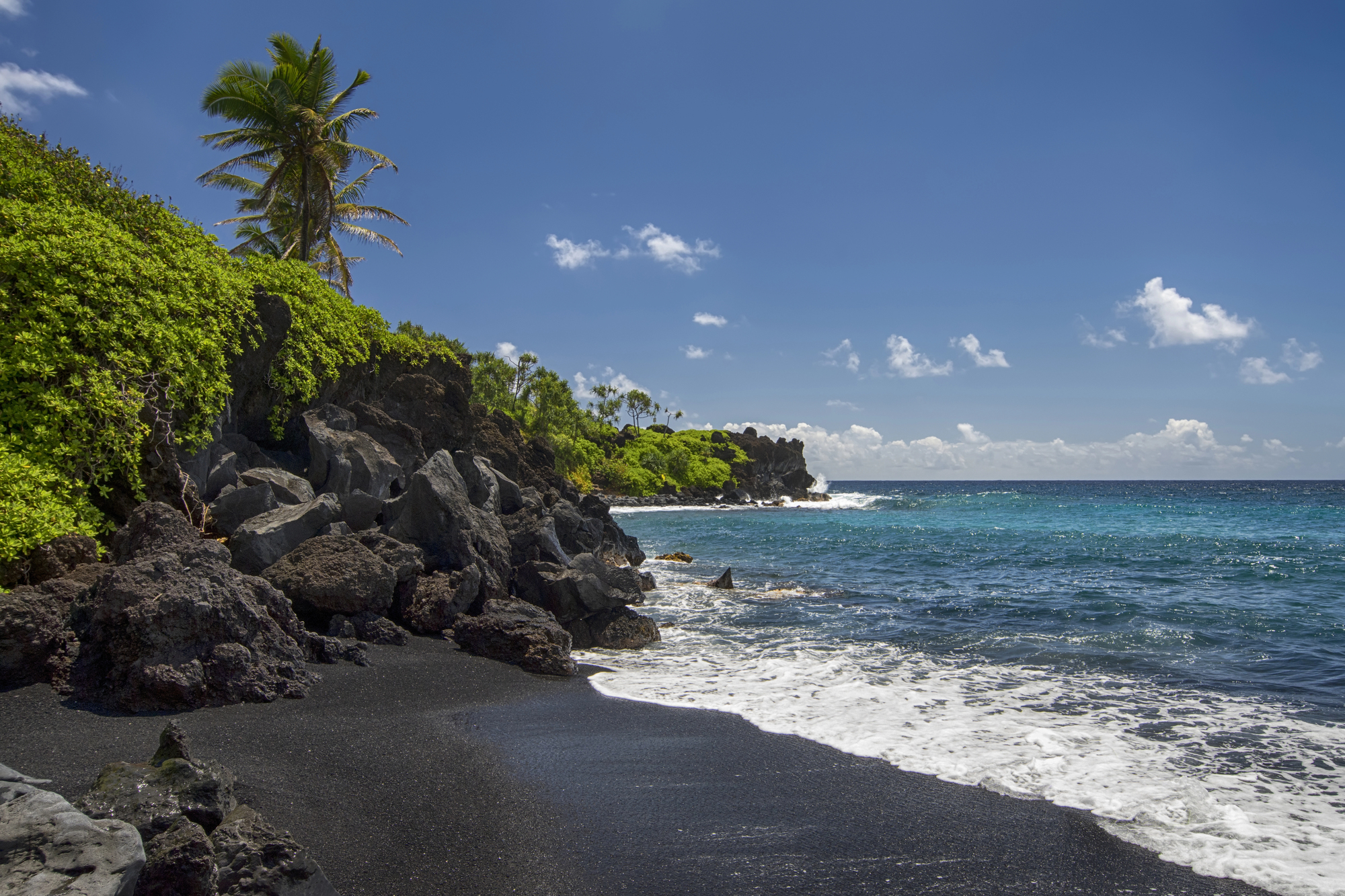
On Maui, the black sand beach everyone pictures sits inside Waiʻānapanapa State Park. This is near mile marker 32 on the Road to Hāna. The name means glistening fresh water, a nod to the lava rock pools that shimmer in the morning light.
Arrive early, before the heat builds. Walk down to the cove and listen. The shore here is made of smooth, dark lava pebbles. Each retreating wave rolls them against each other with a sound like applause from a tiny crowd. Kids tend to stand at the waterline waiting to hear it again.
Do You Need a Reservation for the Black Sand Beach on Maui?
Yes. Visitors who are not Hawaii residents need an advance reservation to enter Waiʻānapanapa. Same day reservations are not offered. Reservations open 30 days ahead, and each time slot comes with a window to arrive.
I have watched a family pull up at the gate after two hours of hairpin turns, only to be turned around because nobody knew. The kids were heartbroken. The parent who planned the day felt it most. Book the moment your date opens, choose a morning slot, and build the rest of your Hāna drive around it.
Beyond the Sand: Sea Caves, Arches, and the Coastal Trail
The cove is only the beginning. A short path leads to lava tubes and sea caves where the air turns cool and the light goes dim. Nearby, a blowhole sends up spray on the right swell, and a natural stone arch frames the surf like a window.
For older kids and strong walkers, an ancient Hawaiian coastal trail winds along the cliffs through native hala forest, with seabirds wheeling overhead. Stay on the marked path and keep drones in the car. Also, treat the heiau, the sacred temple site, with quiet respect. It is a place to walk quietly.
Here’s what you should know before you start planning your family vacation in Maui.
The Ones Worth the Effort
Effort means different things to different people in your group. For a fifteen year old, it is a long walk with nothing to look at but a phone. For a grandmother, it is uneven ground under a hot sun. These next beaches ask more of your family. However, each one gives something back that the easy beaches cannot.
Is the Green Sand Beach Hike Worth It with Kids?

Papakōlea, the green sand beach Hawaii travelers dream about, sits near Ka Lae, or South Point. This is the southernmost tip of the fifty states. The beach curls inside the eroded wall of a cinder cone that erupted roughly 49,000 years ago. Its sand is mostly olivine, and in morning light the cove glows somewhere between olive and deep emerald. Among all the colored sand beaches in Hawaii, none draws more wide eyed stares than this one.
The name Papakōlea means plover flats, after the golden plovers that rest along this coast in winter. Kids love knowing that a beach can be named after a bird.
How Many Green Sand Beaches Are There in the World?
You will read everywhere that there are only four green sand beaches in the world, with the others in Guam, the Galápagos, and Norway. It is a wonderful line to share at dinner. I tell families to consider this information though. Some Big Island experts note that the claim has no clear original source. What no one disputes is that true green sand beaches are rare, and Papakōlea is the most famous of them.
What the Walk Feels Like at Every Age
From the South Point parking area, the dirt track runs about two and a half miles each way across open, windswept land. There is no shade, no water, and no restroom at either end. Most families need two and a half to three hours for the round trip, plus time on the sand.
Your teenager will likely love it. The wind roars, the cliffs drop into cobalt water, and the reveal at the end feels earned.
Your six year old is a different story. By the second mile, the sun is high, the water bottle is empty, and the whining has a rhythm. Children under ten tend to remember the walk more than the beach.
Your mother might choose to stay at South Point instead, watching the ocean churn below the cliffs with a thermos of coffee. That is a lovely morning, not a consolation prize.
You will see pickup trucks at the trailhead offering rides. That road crosses Hawaiian Home Lands, where vehicles are not permitted. The rides are not a licensed service. I recommend that my clients stay away from them, out of respect for the land and the community that cares for it.
Can You Visit Papakōlea Right Now?
Not easily, and possibly not at all for a while. Recent storms have closed areas near this beach. If Papakōlea is on your wish list, ask me to confirm conditions close to your travel dates, and keep Richardson’s green sparkle in your back pocket as a stand in.
Pohoiki, the Black Sand Beach Younger Than Your Kids
Tell your children this: The beach you are about to see did not exist in 2017. In 2018, Kīlauea sent lava pouring into the ocean near Pohoiki in lower Puna. Within weeks the waves had ground that fresh rock into sand and piled it into the bay. It is one of the youngest beaches on Earth.
Standing at Isaac Hale Beach Park, you can see the raw edge of the lava flow that stopped short of the harbor. For a child who loves volcanoes, this is the moment the science book comes alive.
This is a beach for looking, not swimming. A heavy shorebreak and strong currents run along the sand, and big lava boulders line the waterline. Bring your own drinking water, since the park has portable toilets but little else.
Papohaku at Sunset, When White Sand Turns Gold
On Molokai’s west shore, Papohaku stretches for miles. It is one of the largest white sand beaches in all of Hawaii. At midday it is pale and quiet. Stay until late afternoon, though, and something shifts. The low sun hits the fine sand at an angle and it glows gold, then deep orange, while the silhouette of Oʻahu sits on the horizon.
Spread a blanket, unpack a picnic, and let the kids write their names in the sand with a stick. Some of my favorite family photos were taken right here, in that warm light.
Keep everyone far back from the water. There is no protective reef and no lifeguard. The rip currents are strong enough that waves can surge high up the sand without warning. Wear shoes from the parking area, too, because the thorny kiawe trees drop spines that hide in the sand.
Molokai is a quiet island with a deep Native Hawaiian community that values its privacy and pace. Come gently, spend locally, and leave it as peaceful as you found it.
What You Should Skip, or Save for Later
Loving a place sometimes means leaving it alone for a season. Two of the most photographed colored sand beaches Hawaii has to offer land on my skip list right now. I would rather tell you why than let you find out at a closed gate.
Red Sand Beach Maui: Why Kaihalulu Stays Off Our Family List
I understand the pull. Kaihalulu is a small cove on the far side of Hāna, where deep red sand meets cobalt water, and a jagged black lava wall shelters a natural pool from the open sea. The cliffs above it belong to Kaʻuiki Head. This is the hill where Queen Kaʻahumanu, one of the most powerful women in Hawaiian history, was born in 1768. The name Kaihalulu means roaring sea.
And yet the red sand beach Maui visitors share online is one I do not send families to. The only way down is a narrow, crumbling path across the face of the hill, with loose cinder underfoot and a long drop to the rocks. Signs along it warn of injuries and deaths.
The route crosses private land. Storms have eaten away sections of it. The Hāna community has asked visitors to stay away.
If your kids have their hearts set on red, let them fall for it in photos at home. Spend your Hāna day on the black sand and sea caves of Waiʻānapanapa instead.
Punaluʻu, Hawaii’s Most Famous Black Sand Beach, Waiting on Its Future
For generations, Punaluʻu on the Kaʻū coast has been the black sand beach families pictured first. Coconut palms lean over sand that looks like crushed obsidian, flecked with silver when the sun catches it. For decades it hosted local birthdays, graduation parties, and family reunions, the kind of beach that holds a community’s memories.
Why Honu Choose Black Sand
Punaluʻu has long been one of the best places in Hawaii to see sea turtles resting on the shore. Dark sand soaks up the sun’s heat, and honu haul out to bask on it the way a cat finds the one warm patch on the kitchen floor. The first time children see a turtle asleep on the sand, its shell dusted with black grains, they start whispering, as if it might wake up and leave.
What Changed in 2026
This year, the ground shifted under Punaluʻu in more ways than one. The county had leased the beach park from private landowners since at least 1954, but negotiations with the current owner ended without a new agreement. Therefore, county park services stopped after August 29. The restrooms, parking area, and pavilions now belong to the landowner. The long term plan for public access has not been settled.
The landowner has said public access to the beach will remain, and the county has pledged to protect it. Until the details are clear and the community has had time to recover, I am holding Punaluʻu for a future trip and steering turtle lovers toward other shores.
Before You Go: Keeping Little Feet and Little Swimmers Safe
The difference between a magical beach day and a hard one often comes down to three small things nobody mentions in the glossy photos. Here is what I tell every family before they set out for the colored sand beaches Hawaii is known for.
Why Black Sand Burns Little Feet
It happens every time. A child kicks off her sandals at the edge of a black sand beach and takes three running steps. She then starts hopping from towel to towel like the ground is lava, because in a way it still is. Dark sand soaks up the midday sun and holds that heat far longer than pale sand does.
The fix is simple. Pack water shoes for everyone and plan your black sand visits for the morning or late afternoon. Also, keep little ones on the cool, damp sand near the waterline where the waves have washed the heat away. Grandparents appreciate that last tip as much as the kids do.
Reading the Ocean Before Anyone Wades In
Several of the beaches in this guide have no lifeguard, and help can take a long time to reach remote shores. The Hawaiian surf also has a way of fooling visitors. From the sand, the water looks calm. Then a set of waves rolls in, catches the sloping bottom, and breaks with enough force to knock an adult off her feet.
Before anyone steps in, sit and watch the water for ten full minutes. Check the state’s ocean safety site at HI Ocean Safety for current surf and hazard reports. And follow the rule my own family lives by: If the local families are not swimming, neither are we.
How Close Is Too Close to a Honu?
NOAA Fisheries recommends staying at least ten feet away from sea turtles, both on the sand and in the water. Basking turtles can be so still that they seem asleep or even lifeless, and that is normal. They are resting, warming up, and saving their energy.
Turn it into a game. Before you leave for the beach, have the kids measure ten feet on the hotel room floor in their own footsteps. When a honu hauls out, they already know how far back to stand, and they become the ones reminding the adults. No touching, no feeding, and no chasing, ever.
Planning a Multigenerational Hawaii Beach Trip Around the Sand

A multigenerational Hawaii beach trip works when every person in the car gets a moment that belongs to them. The teenager gets the wild coastline. The little one gets the tide pool. The grandparents get a shaded bench, a view, and the sight of all of them together.
What’s the Best Hawaii Island for a Family Beach Vacation?
If sand color is the star of your trip, the Big Island is the best Hawaii island for a family beach vacation. It is one of the few places on Earth where you can see black, green, and white sand in a single stay. It holds more of the colored sand beaches Hawaii is famous for than any other island.
The tradeoff is distance. The Big Island is larger than all the other Hawaiian Islands combined. The drive from the Kona side to South Point alone takes about an hour and a half.
I once planned a family’s week around two home bases. A few nights on the dry, sunny Kona coast and a few nights near Hilo. The grandparents said afterward that the move was the best part. Fewer hours in the car meant more hours at the water.
Maui makes a lovely second choice if your family also wants the Road to Hāna, rainforest waterfalls, and a gentler beach day between adventures.
Creating a Colored Sand Beaches Hawaii Day That Works for Three Generations
Here is the rhythm I use for Hawaii colored sand beaches with kids and grandparents in the same car.
Start early, while the sand is cool and the water is glassy. Morning belongs to the easy beach: Tide pools, snorkel masks, and a turtle sighting if luck is with you.
By late morning, head inside. Lunch in the shade, naps for the littlest travelers, and a slow afternoon for anyone whose knees are talking back.
Then go out again for the golden hour. A sunset stroll on soft sand, a picnic on a blanket, and a sky that turns every photo into the one you frame. One beach before lunch and one after the heat breaks is plenty. Families who try to collect every color in a single day usually remember the car more than the coast.
When Should Your Family Go?
Hawaii’s hurricane season runs from June 1 through November 30, with the peak between July and September. Most years pass quietly, but some years are quite active.
Winter brings its own challenge, as big surf builds along exposed shores and beaches like Papohaku grow more hazardous in fall and winter. That is why I often recommend late spring to my clients. April and May fall after the biggest winter swells and before storm season begins, with long, warm evenings for those sunset walks. Whatever month you choose, I watch the forecasts and park notices for you right up until your flight.
Check out the best beaches in Oahu for your family vacation.
Can You Take Sand Home from Hawaii?
On the last morning of almost every trip, someone produces an empty jar. Maybe it is your son, holding a water bottle he has quietly filled with green sparkle. Maybe it is you, thinking how lovely a little black sand would look on the windowsill back home.
Can you take sand home from Hawaii? No. State law bans removing sand, rocks, dead coral, and other beach deposits from the shoreline. The fines are steep if you do. The law makes room for the grains that cling to your feet, towels, and slippers, and for traditional Hawaiian cultural practices. A jar of it does not qualify.
There is a gentler reason, too. Many Hawaiians see the sand and stones as part of the land itself. Island lore warns that Pele, the goddess of the volcano, does not take kindly to visitors who carry pieces of her home away. For kids, that story lands harder than any rule.
The colored sand beaches Hawaii has today exist because every visitor before us left them whole.
Souvenirs That Honor the Sand
The best keepsakes from these beaches weigh nothing at all. Try these with your crew.
Start a sand color journal. At each beach, the kids sketch the shoreline, color in the sand with pencils, and write one sentence about how it felt underfoot. By the end of the trip, they have a small book no one else in the world owns.
Take a close-up photo of sand in a child’s palm at every stop. Black, green flecked, gold at sunset. Lined up on a wall at home, those palms tell the story of the colored sand beaches Hawaii shared with your family, one handful at a time.
And let them draw in the sand before you leave, a name, a turtle, a heart, then watch the next wave carry it out to sea. It is the one thing they are allowed to leave behind.
Ready to Hand Someone Else the Map?
Picture it. You are sitting on warm black sand while the kids crouch over a tide pool and Grandpa reads a book in the shade. You did not spend a single night searching road closures, reservation windows, or surf reports. Someone else planned that. All you had to do was show up and watch your family fall in love with the colored sand beaches Hawaii saved for them.
Are you ready to start planning the family trip where the sand is part of the story?
If you said yes, I would like to invite you to schedule a planning session with me by clicking here. Clicking this link will take you directly to my digital calendar to set up a time that is convenient for you.
And if you aren’t ready to start planning just yet, you can sign up for my newsletter here. This will ensure we stay in touch as I share helpful travel information with you in the future.

Tracy is the owner of Elite Travel Journeys, a luxury travel agency dedicated to crafting extraordinary, memory-making journeys for families, multigenerational groups, empty nesters, and solo female travelers. A proud military veteran and President of the Central PA Chapter of ASTA, Tracy brings both discipline and deep passion to everything she does. With a particular love for river cruising, especially Europe’s enchanting Christmas Markets, she has been turning travel dreams into life-changing experiences since 2014. Tracy believes that extraordinary travel doesn’t just take you somewhere new; it changes who you are.
Enter your Name and best Email Address to receive
On Your Next Family Vacation
We respect your privacy and will never share or sell your information.
3 Ways to See It All in Alaska


On Your Next Family Vacation
Click here for 10 Exciting Family Adventures
You Can Plan
NOW