Waterfalls on the Big Island of Hawaii Every Generation Can Enjoy
Somewhere between the rental car and the waterfall, one of your family members is going to meet a staircase they can’t climb. Maybe it’s your mother, who swore her knee was fine. Maybe it’s the stroller holding your sleeping two-year-old. The waterfalls on the Big Island of Hawaii are worth every mile of the drive, but only when the itinerary already knows who is walking beside you.
Picture the morning. Grandpa leans on his cane at the trailhead. Your ten-year-old is halfway up the path before the car doors close. You stand in the middle, doing the questioning you always do: Who can manage what, and for how long?
This guide does that questioning for you. Every waterfall below comes with its story and a plain answer about who in your family can reach it.
Waterfalls on the Big Island of Hawaii Every Generation Can Enjoy
Why the Best Waterfalls on the Big Island Live on the Rainy Side
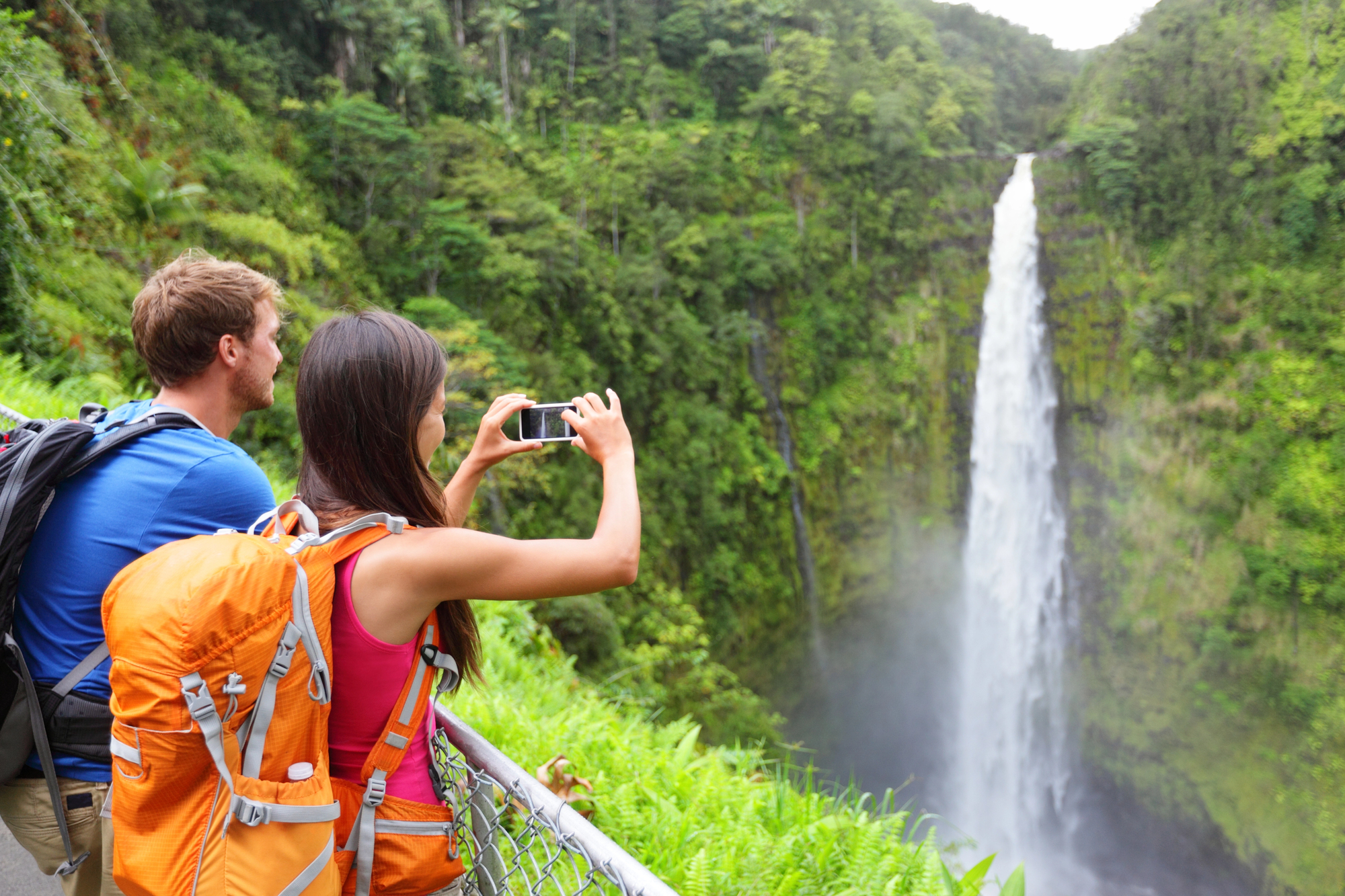
Nearly every waterfall worth the drive sits on the island’s wet eastern side, around Hilo and up the Hāmākua Coast. Trade winds push ocean moisture up the slopes of Mauna Kea, and the clouds release it there. Hilo collects more than 100 inches of rain a year. Parts of Kona see only 20 to 30.
You can feel that difference through the windshield. Leave the Kona side and the land starts out black and bare, old lava running down to the sea. Somewhere past the island’s middle, green creeps in along the roadside. By the time you reach Hilo, ferns drip over the guardrails and every gulch seems to hold running water.
That rain is the reason the waterfalls on the Big Island of Hawaii exist at all. It is also why a light shower on waterfall day is good news rather than a spoiled plan.
Check out the best waterfalls in Hawaii, island by island.
Are There Waterfalls Near Kona Worth the Drive with Kids?
Yes, though the closest public falls sit about two hours away on the Hilo side. Families staying near Kona have two ways to handle that distance.
The first is a private waterfall reserve in the North Kohala forest. It is far closer to the resorts than anything near Hilo. It is reached only with a guide, and you’ll find it in the swimming section below.
The second is the one I nudge most families toward. Instead of one long round trip, move to the Hilo side for a night. Kids who doze off in the car on the way over wake up rested in a town where the next waterfall is ten minutes away. Pair that night with a day at Hawaiʻi Volcanoes National Park, and the drive becomes a chapter of the trip instead of a chore.
When Do the Waterfalls on the Big Island of Hawaii Run Fullest?
They run fullest in the wet season, roughly October through April. This is when the Hilo and Hāmākua slopes get their heaviest rain. Late spring is my favorite window for families. The rivers still carry winter’s water while the skies begin to clear.
Summer brings thinner falls, never dry ones, because the windward side collects showers all year. Whatever the month, go early. Morning light slants through the mist. The parking lots are quieter. And little ones are fresh instead of wilting.
Which Waterfalls on the Big Island of Hawaii Work for Every Generation?
Picture three generations at one trailhead. Grandma has a cane and strong opinions about stairs. The baby is asleep in the stroller, and nobody wants to wake her. The twelve-year-old wants to swim beneath something tall. One waterfall day can offer all three things, as long as each stop matches the people standing at it.
When families ask me for family friendly waterfalls, Big Island trips sort neatly into four kinds of stops:
- Rolling right up to the view: Rainbow Falls, where a railed lookout sits a few steps from the car. For anyone searching for wheelchair or stroller accessible waterfalls, Big Island travelers will find no easier start.
- Short walks with no stairs: The drive-up overlook at Umauma Falls, a gentle choice for walkers and canes.
- Steady walkers who can manage steps: The ʻAkaka Falls loop and the garden path to Onomea Falls.
- Confident swimmers: Kulaniapia Falls outside Hilo and the Kohala forest reserve, both on private land with someone watching the water.
One more option works for every age at once. A guided van ride down into Waipiʻo Valley lets everyone stay seated while one of the tallest falls in Hawaiʻi comes into view.
Rainbow Falls Hilo: The Easiest Waterfall on the Island
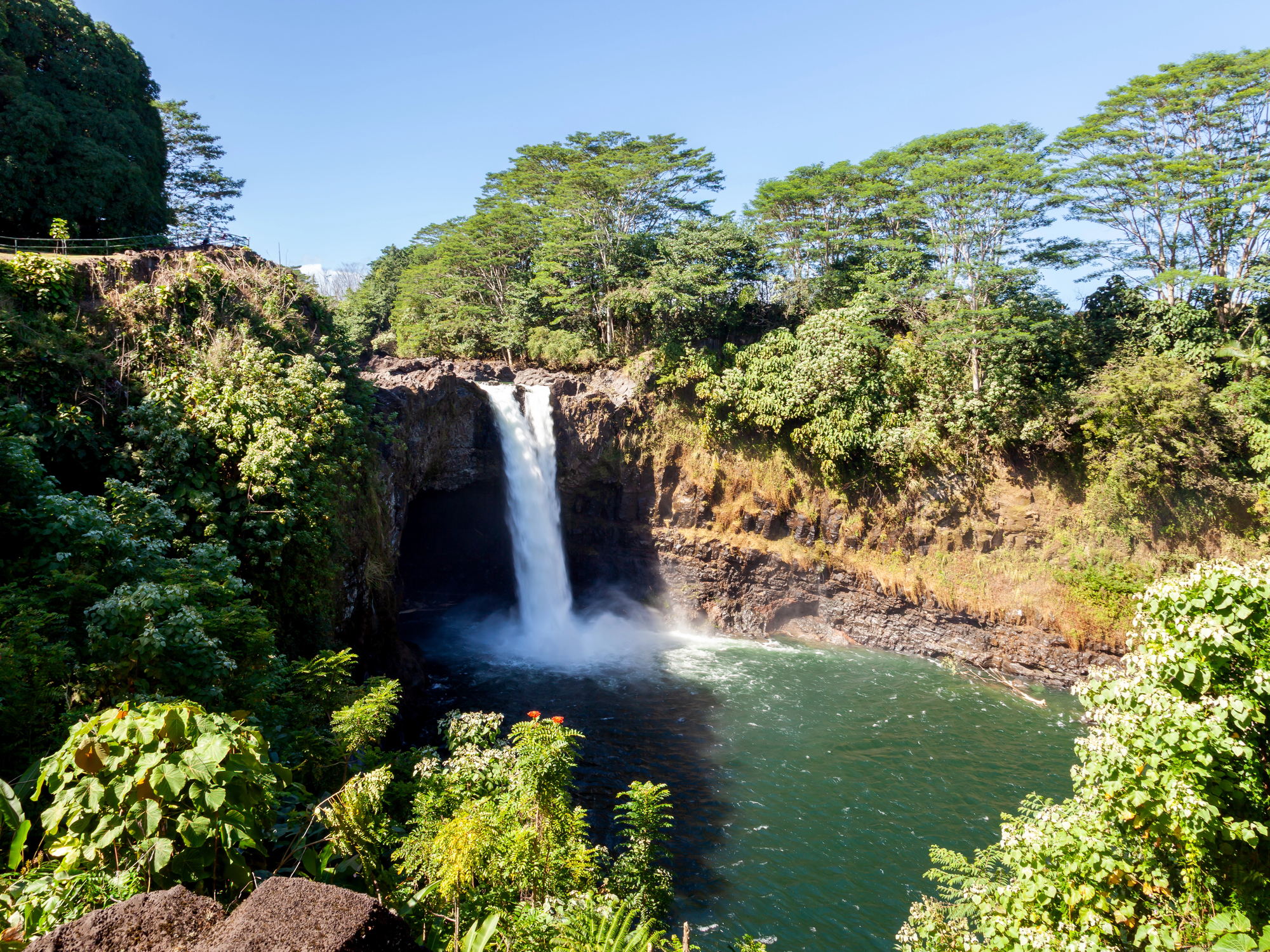
Rainbow Falls pours 80 feet over a lava ledge into a round pool on the Wailuku River. It is about two miles from downtown Hilo. Of all the waterfalls near Hilo, it’s the one I put first on almost every family’s list.
Come on a sunny morning around nine or ten. Stand with the sun at your back and watch the mist below the falls. Picture a grandfather lifting a six-year-old onto his hip at the railing. For a moment, nothing happens. Then the color arrives, a soft arc floating over the pool, and she grabs his collar and points as if she conjured it herself.
That pool is a place for looking, not swimming. The park keeps visitors out of the water. Walk a few minutes up the path beside the lookout instead. You’ll find a second view and an enormous banyan tree whose hanging roots make perfect hiding spots. Kids tend to vanish into them.
What Legend Lives Beneath Rainbow Falls?
The falls carry the Hawaiian name Waiānuenue, often translated as rainbow water. Beneath the falls sits a cave. Legend says it was the home of Hina, mother of the demigod Maui.
Save this story for the railing. Tell the kids that Hina lived under the falls, then watch them squint at the dark space behind the water, searching for her. A moment like that turns a quick photo stop into the part of the trip they retell at Thanksgiving.
Boiling Pots and Peʻepeʻe Falls, Five Minutes Upstream
Drive a little farther up the river and it changes character completely. At Boiling Pots, the Wailuku churns through a chain of deep pools that roll and bubble as if heated from below. Six-sided basalt columns line the pools, formed as lava cooled slowly long ago. Kids love counting the sides.
Peʻepeʻe Falls spills over a wide ledge upstream, seen from a railed overlook farther back than at Rainbow Falls. The pools look inviting, but water moves between them through hidden underground channels. Everyone stays behind the rails here.
Is Rainbow Falls Still Free?
Not for visitors. Since January 2026, Wailuku River State Park has charged non-residents an entry fee per person plus a parking fee per car. Hawaiʻi residents with ID and children three and under enter free. Payment is by credit card only. One payment covers both Rainbow Falls and Boiling Pots..
The Akaka Falls Hike: A Rainforest Loop With a 442-Foot Finale
ʻAkaka Falls plunges 442 feet into a stream-carved gorge, taller than a forty-story building. The paved loop that reaches it runs only 0.4 miles. This puts it among the easy waterfall hikes Big Island families can finish before anyone asks for a snack.
The park sits at the end of a winding road above the old plantation town of Honomū, about 15 miles north of Hilo. Plan on thirty to forty-five minutes on the trail.
Of all the waterfalls on the Big Island of Hawaii, this is the one I’d choose if a family had time for only one.
Walking Akaka Falls With Kids
The trail begins with steps down into the green, and the air changes the moment you take them. It turns cool and damp and smells like crushed leaves. Bamboo towers overhead and creaks when the wind moves through it. Orchids and red ginger crowd the edges of the path.
Kids will run ahead, and on a railed, paved trail that’s fine. Somewhere along the way they’ll reach Kahuna Falls. This is a slender ribbon of water sliding down the far wall of the gorge. Expect someone to announce that you’ve arrived. Let them enjoy it, then tell them to keep walking.
Around the next bend the path opens, and ʻAkaka appears all at once. One unbroken column of white water drops into the gorge while its mist drifts up to meet you. Even the teenager who swore this would be boring goes quiet.
Can Grandparents and Strollers Do the Akaka Falls Loop?
Strollers, no. Grandparents, often yes, with the right route. The loop includes several sets of steps and is not wheelchair accessible. Leave the stroller in the car and bring a baby carrier instead.
For anyone who wants the big waterfall without the full loop, take the path to the left at the first junction. It reaches the ʻAkaka viewpoint in a short walk and skips Kahuna Falls entirely. Grandma sees the main event, then settles at the picnic tables near the parking lot while the kids loop around the long way. Everyone goes home with the same photo.
Before You Pull Into the Lot
Pay your visitor entry and parking online before you leave Hilo. Cell reception at the park is weak, and nobody wants to stand in the rain refreshing a payment page. Sometimes part of the trail closes after a storm. This is a reminder to check the state park page the morning you go.
Check out the best hikes on the Big Island of Hawaii before you plan your family vacation.
Hamakua Coast Waterfalls Worth a Slow Drive
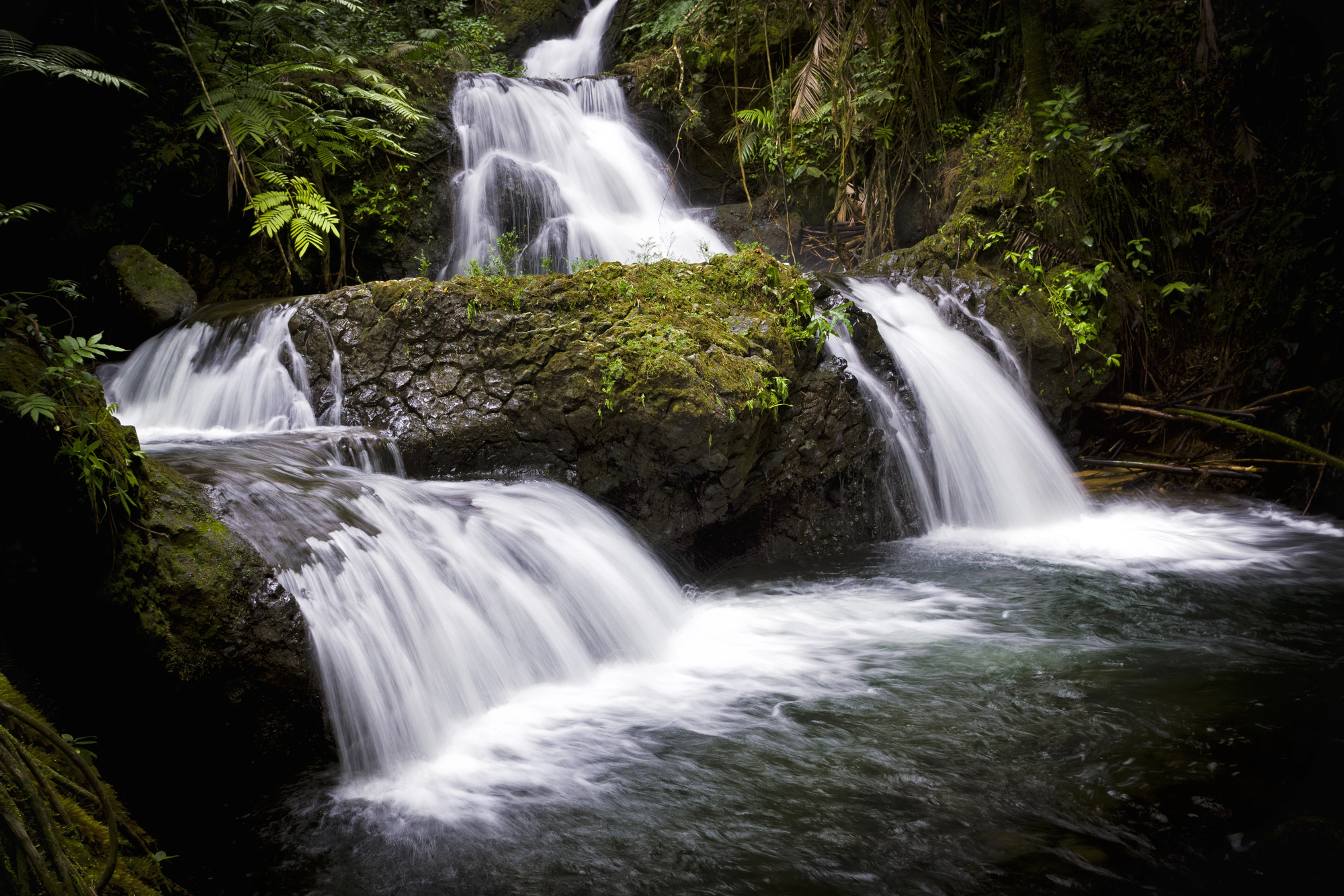
North of Hilo, Highway 19 traces the Hāmākua Coast along cliffs above the sea, crossing gulch after gulch. Each gulch cuts a green notch into the land, and many hide a waterfall at the back. This is a drive to take slowly.
Stop at a roadside stand for rambutan, let the kids pick the next pullout, and treat the Hamakua Coast waterfalls as a string of small discoveries rather than one big destination.
Umauma Falls and Its Three Tiers
Umauma Falls drops in three separate tiers, one stacked above the next. It is a shape found nowhere else in Hawaiʻi. The falls sit on private garden land about 16 miles north of Hilo, and a garden admission includes the overlook.
Picture it after a rainy night. All three tiers are roaring at once, the pools between them are churning white, and your whole family stands shoulder to shoulder at a sturdy railing. Nobody needs to climb a single step to feel the rumble.
Onomea Falls Inside a Tropical Garden
Onomea Falls lives inside a nonprofit tropical botanical garden along the scenic four-mile drive near Onomea Bay. A garden ticket is the only way in, and the garden is half the reason to go. The path winds down through towering palms and bursts of heliconia toward the sea, with the falls tumbling in small tiers along the way.
Give yourselves time to wander before and after the falls. Hand the kids the camera and challenge them to find the strangest flower in the garden. Bring rain jackets, because the paths stay damp. A few stretches run steep, with handrails in most places. Grandparents will feel them most on the walk back uphill.
Nanue Falls, Best Enjoyed From the Bridge
Nanue Falls is a series of cascades on Nanue Stream, about 18 miles north of Hilo along the Old Māmalahoa Highway. The lower falls are visible from the bridge, and that view is the one I recommend.
You may read that larger falls wait upstream. Reaching them means scrambling up a steep streambed over slick boulders, with mosquitoes and serious flash-flood danger. That’s no place for a family. Pull over, let everyone lean on the bridge rail for a few minutes, and listen to the water. Then drive on while the day still feels easy.
Big Island Waterfalls You Can Swim In, and the Ones You Can’t
The public falls here, ʻAkaka included, are for looking only. The waterfalls on the Big Island of Hawaii that welcome swimmers sit on private land, where someone watches conditions and decides each day whether the water is safe. That oversight is exactly what makes them right for a family swim.
Kulaniapia Falls, a Private Swim Outside Hilo
Kulaniapia Falls drops about 120 feet into a wide pool in the hills above Hilo. The falls sit on the grounds of a small inn. Visitors come in as overnight guests or with a day pass booked ahead. I arrange that access for my clients, along with the add-ons that fit each group.
When conditions allow, you can swim, kayak, or paddleboard beneath the falls. Older kids and teens can also try waterfall rappelling. Imagine your fifteen-year-old at the top of the cliff, harness snug, and a guide steady beside her. She leans back, takes one step down the wet rock, and suddenly she is the bravest person in the family. That’s the story she’ll tell for years.
A Waterfall Swim Deep in the Kohala Forest
On the island’s northern tip, a private nature reserve in the Kohala forest holds a chain of waterfalls reached only with a small guided group. Guides pick up near Kona and the Waikōloa resorts, drive north through old plantation towns, and head off road to the trailhead.
The walk is short but can turn muddy. It follows the tunnels and ditches of a century-old sugar plantation past several falls, then ends at a pool where everyone finally gets in. The day wraps with a picnic above the sea cliffs. It suits a wide range of ages, as long as everyone can handle uneven, rocky ground.
Two Rules Before Anyone Gets Wet
First, check every scrape. Leptospirosis, a bacterial infection found in Hawaiian fresh water, can enter the body through cuts and blisters. Anyone with a wound that can’t be covered stays on the bank.
Second, watch the sky upstream, not only overhead. Streams here can rise fast after rain falls miles away in the mountains. If it’s raining anywhere above you, or the water turns brown, everyone gets out. On private land, the guides make this call for you, one more reason I send families there.
How Do You See Hiilawe Falls in Waipio Valley Today?
Hiʻilawe Falls drops more than 1,200 feet down a mossy green wall at the back of Waipiʻo Valley. For generations, visitors hiked in to see it. That is no longer possible. The steep road into the valley has been closed to visitors since February 2022 because of rockfall and slope hazards. Nobody can walk, hike, or drive down on their own.
The lookout at the top remains open. Stand at the rail and the whole valley unfolds below you: Taro patches, a river winding toward a black sand beach, and cliffs rising on every side.
The only way to reach this Waipio Valley waterfall from the valley floor is a guided ride with a family-run shuttle whose drivers have deep roots in the valley. The van rolls down with its windows removed, and wild horses often wander right up to it. Hiʻilawe comes into view on the descent, and the ride stops for photos. You’ll see it from a distance, because the land around the falls is private.
That distance carries its own reverence. Waipiʻo is known as the Valley of the Kings, a sacred place once home to Hawaiian royalty. Of all the waterfalls on the Big Island of Hawaii, this one asks for the most patience and gives back the most story.
What Happens to Big Island Waterfalls When the Weather Turns?
Rain feeds these falls, and some years it arrives with force. Storms can close a trail for days while crews clear fallen trees.
Planning Big Island waterfalls with kids means building in room to pivot. I check the state parks notice page the morning of every waterfall day, and I keep a backup ready for each stop. A closed gate means closed, no matter how quiet the trail looks behind it. When a plan shifts, the family never feels the scramble. They wake up to a different adventure.
Pack for the windward side: Rain jackets, shoes with good grip, bug spray, and a dry change of clothes for every child. The waterfalls on the Big Island of Hawaii reward families who arrive ready for a little weather. After all, a little weather is part of their magic.
Your Family’s Waterfall Morning Is Waiting
Somewhere on that island, a railing is waiting for your family. Mist will hang over the water, and a small hand will tug at a sleeve. A grandparent will stand beside a teenager, and for once nobody will reach for a phone first. I plan those mornings around the waterfalls on the Big Island of Hawaii, matched to every knee, stroller, and swimmer in your group.
Are you ready to start planning the trip your whole family will be retelling for years?
If you are ready, I would like to invite you to schedule a planning session with me by clicking here. Clicking this link will take you directly to my digital calendar to schedule a time that is convenient for you.
And if you are not ready to plan your next family vacation right now, you can easily sign up for my newsletter here. This will ensure you continue to receive all the incredible travel information I share.

Tracy is the owner of Elite Travel Journeys, a luxury travel agency dedicated to crafting extraordinary, memory-making journeys for families, multigenerational groups, empty nesters, and solo female travelers. A proud military veteran and President of the Central PA Chapter of ASTA, Tracy brings both discipline and deep passion to everything she does. With a particular love for river cruising, especially Europe’s enchanting Christmas Markets, she has been turning travel dreams into life-changing experiences since 2014. Tracy believes that extraordinary travel doesn’t just take you somewhere new; it changes who you are.
Enter your Name and best Email Address to receive
On Your Next Family Vacation
We respect your privacy and will never share or sell your information.
3 Ways to See It All in Alaska


On Your Next Family Vacation
Click here for 10 Exciting Family Adventures
You Can Plan
NOW