Best Family Hikes in New Zealand: The Walks Worth Crossing an Ocean For
The hardest part of planning family hikes in New Zealand has nothing to do with the climb. It is finding one trail that works for a six-year-old and her grandfather on the same morning.
I watched a family solve that puzzle on a swing bridge above a milky, glacier-fed river. The little girl counted the planks out loud. Her grandfather walked two steps behind, one hand on the cable, grinning like he was the one turning six. Her mother caught my eye and smiled. The mountain at the end of the valley had not even come into view yet.
That moment is why I plan trips around walks. A good trail gives a family something no schedule can: Hours together with nowhere else to be. Below, I match each walk to the people walking it, from toddlers in carriers to teens chasing a volcanic summit. If you are dreaming about the best family vacation New Zealand can offer, start here.
Best Family Hikes in New Zealand: The Walks Worth Crossing an Ocean For
What Makes Family Hikes in New Zealand Different?

New Zealand’s conservation tracks are signposted with walking times, not only distances. That small detail changes everything for a parent. You glance at the sign, check the clock, and know whether the walk fits before the next snack emergency.
The range is the other gift. In a single day, your family can wander a 15-minute mossy loop in the morning and stand beside an iceberg-dotted lake by late afternoon. Most day walks need no permit or booking. That freedom is what makes family hikes in New Zealand feel spontaneous. Even when I have planned every detail behind the scenes.
The best hikes in New Zealand for your family are not always the most famous ones. They are the ones matched to the shortest legs and the oldest knees in your group. That is how I have organized everything that follows.
Check out what to do in every region of New Zealand during your family vacation.
Which Easy Hikes in New Zealand Work for Little Legs?
These are the short walks New Zealand families lean on when the youngest walker is under seven, or still riding in a backpack carrier. Each one rewards small feet within minutes.
Kamahi Loop Track and the Goblin Forest
On the North Island’s west coast, Taranaki Maunga rises in a near-perfect cone above Te Papa-Kura-o-Taranaki, the national park once called Egmont. On its eastern slopes, the Kamahi Loop Track wanders 600 metres through what locals call the Goblin Forest. Allow about 15 minutes, including a few steps and a footbridge.
The kamahi trees here twist into crooked shapes, wrapped in trailing moss. Light arrives green and soft. Kererū, the plump native pigeons, crash between branches with a sound like someone shaking out a blanket.
Here is my favorite trick. Before you start, tell the kids a story about the goblins who guard this forest. At the end of the loop, announce that they have survived the Goblin Forest. They will beg to walk it again, this time searching every mossy hollow for a goblin door.
Lake Matheson’s Mirror Walk
On the South Island’s West Coast, near Fox Glacier, Lake Matheson holds one of the country’s most famous reflections. On a still morning, Aoraki/Mount Cook and Mount Tasman appear twice: Once in the sky and once upside down in the dark water.
That darkness is the secret. Organic matter leaches from the forest floor and stains the lake brown, turning its surface into a mirror. Kids love hearing that a retreating glacier carved this hollow about 14,000 years ago and left water behind.
The full circuit is 4.4 km and takes about an hour and a half. With a toddler, aim for the Jetty Viewpoint instead: 2.4 km in about 45 minutes while crossing a suspension bridge on the way.
That first section suits assisted wheelchairs, which helps if a grandparent uses one. Dawn and dusk bring the stillest reflections, and the camera will not leave your hand.
Cape Foulwind Walkway and the Seal Colony
Near Westport, farther north on the same coast, you will smell the seal colony before you see it. Salt spray, sun-warmed rock, and something distinctly fishy. The kids will wrinkle their noses, then rush to the railing anyway.
From the Tauranga Bay car park, a 500-metre path reaches the seal colony viewpoint in about 15 minutes. It is accessible for buggies and assisted wheelchairs. Below, New Zealand fur seals sprawl across the rocks, barking and squabbling. The colony is busiest during the breeding season, from November to February.
Older walkers can continue 2.9 km to the Cape Foulwind lighthouse, about an hour one way. Signs along the walkway explain how Captain James Cook named the cape in 1770, after westerly winds blew his ship off course. The cliffs drop steeply, so hold small hands. Pair the walk with an afternoon on a nearby beach.
Family Hikes in New Zealand for School-Age Adventurers
Somewhere around age seven, kids stop asking “how much longer?” and start asking “what’s next?” These New Zealand hikes with kids in mind answer with swing bridges, lava caves, and summits worth bragging about.
Hooker Valley Track: Three Swing Bridges and a Lake Full of Ice

In Aoraki/Mount Cook National Park on the South Island, the Hooker Valley Track follows a glacial river toward the country’s highest mountain. The route is about 10.6 km on gravel with some steps and only gentle climbing. Most families finish in three to four hours.
The swing bridges steal the show. Kids race ahead to each one, then slow to a tiptoe the moment the deck starts to sway. The second bridge is brand new. It opened in July 2026 and stretches 189 metres across the Hooker River. It is the longest suspension bridge in New Zealand.
Early on, a lookout opens over Mueller Lake. Restrooms are located approximately 15 minutes past the second bridge. This is a detail every parent will appreciate. The track ends at Hooker Lake, where chunks of floating ice drift beneath Aoraki. Pack a picnic and let the kids count icebergs while you take in the mountain.
Rangitoto Island Summit and the Lava Caves
Rangitoto is a young volcanic island in the Hauraki Gulf, about 25 minutes by ferry from downtown Auckland on the North Island. The island is a pest-free sanctuary. Every visitor completes a biosecurity check before boarding. Kids take this seriously, inspecting their shoe treads for stowaway seeds.
The Summit Track climbs 2.3 km and about 260 metres through lava fields and the world’s largest pōhutukawa forest. Allow two to three hours for this New Zealand walk. At the top, the gulf and Auckland’s skyline spread out below you.
On the way down, take the 15-minute side trail to the lava caves. The tunnels are hollowed out by flowing lava. Bring a flashlight for each child, because there is total darkness inside. The rough lava rock can challenge younger walkers. Nothing is sold on the island, including drinking water. So, you must bring every snack with you.
Mautohe Cathedral Cove
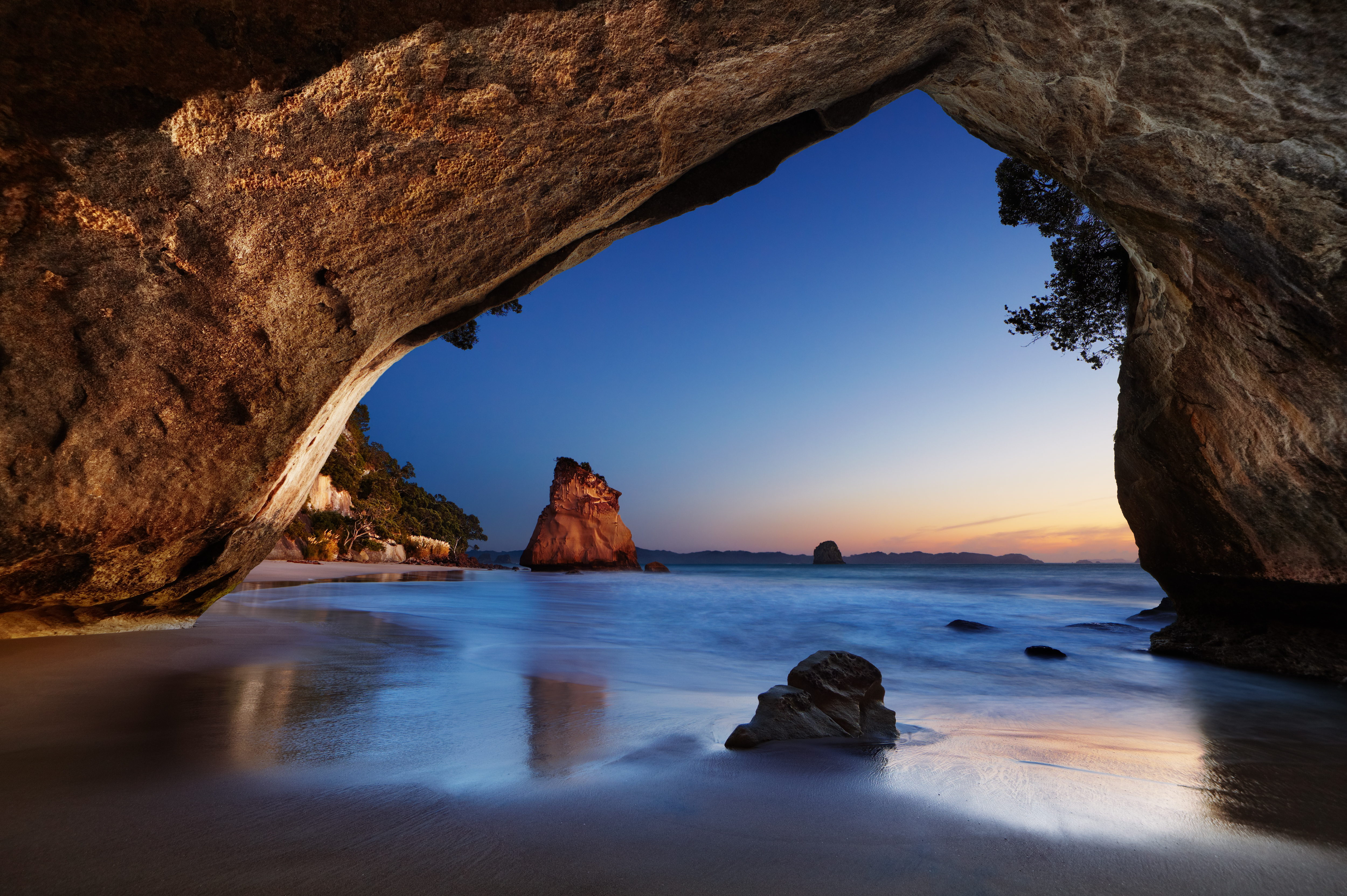
On the Coromandel Peninsula, the walk to Mautohe Cathedral Cove ends at a soaring rock arch framing the sea. Stairs and boardwalk lead down through forest to the sand, where small sea caves invite exploring and offshore rock stacks catch the morning light.
This coastline is still being shaped by weather. Storms closed the track in 2023, and walking access returned in December 2024. A January 2026 storm closed it again until a geotechnical inspection cleared it to reopen. DOC describes the area as naturally unstable. Check the track status on the DOC website the morning you go, and keep children well back from the cliff bases.
Mauao, the Mount Maunganui Summit
On the Bay of Plenty coast, Mauao rises at the end of a narrow peninsula of beach and town. The climb mixes gravel paths and stone steps. Sheep sometimes graze near the base. Cloud can settle over the top, yet even a partial view of the harbour and the long curve of surf beach rewards the effort. Finish with a swim at the bottom.
Where Can Teens Take On a Real Challenge?
Teenagers want a story they can tell their friends. These three walks hand them one.
Tongariro Alpine Crossing with Kids: Is Your Family Ready?
On the North Island, the Tongariro Alpine Crossing traverses a volcanic landscape of steaming vents and crater lakes inside a UNESCO dual World Heritage park. Many call it the finest one-day walk in the country. It is also a serious alpine day.
How to Know If Your Teen Is Ready
The crossing covers 19.4 km and reaches 1,886 metres at Red Crater. Plan on six to eight hours of steady walking. Maybe longer with frequent stops. Local guidance suggests a starting age of 10 to 12.
My readiness test is simple. Before you fly, take the family on a local hike of four or five hours with real climbing. If everyone finishes tired but cheerful, you are ready. If the last hour was misery, choose a shorter walk this trip and save the crossing for the next one.
Weather decides the day, not the calendar. Check the forecast for wind and chill as well as rain, and be ready to postpone. There is nowhere to refill water along the route.
What the Day Feels Like
You start early, in cold thin air, climbing past old lava flows. The ascent to Red Crater is the hardest stretch, with loose ash crunching underfoot. Then the ground falls away, and the Emerald Lakes appear below. They are impossibly green against dark volcanic slopes.
Teens who grumbled at the trailhead go quiet. The final descent winds through tussock and can feel endless. That is where family jokes and trail snacks earn their keep.
Rob Roy Glacier Track
In Mount Aspiring National Park, about an hour’s drive west of Wānaka on the South Island, the Rob Roy Glacier Track climbs from farm flats into a valley of hanging ice. The return walk is about 10 km and takes three to four hours.
The approach is half the adventure. The last 30 km of road is unsealed. Its final stretch crosses fords that can flood after rain. Choose a settled day and start early.
A swing bridge crosses the West Matukituki River, then the track climbs through beech forest beside a rushing stream. Kea, the cheeky alpine parrots, sometimes appear. At the top, waterfalls pour off sheer cliffs beneath the glacier. Unpack lunch at the lookout, then sit quietly and listen. You may hear the ice groan and crack across the valley.
From May to November, avalanche risk can restrict walkers to the lower lookout.
Te Werahi Loop at the Top of the Country
At the northern tip of the North Island, near Cape Reinga, the Te Werahi Loop crosses paddocks, scrub, and golden sand dunes to reach wild west coast beaches. The full loop runs about 16 km and takes four and a half to five hours from the Te Werahi Gate car park.
For a shorter walk, a 2 km track leads from the Cape Reinga lighthouse walk down past steep cliffs to the long sweep of Te Werahi Beach. It is about a 45 minute walk.
Teach your teens one custom before you go. Cape Reinga is sacred to Māori. Eating there is considered culturally inappropriate. Save the picnic for the beach.
What Are the Best Multigenerational Hikes in New Zealand?
The best multigenerational hikes New Zealand offers share three traits: A flexible distance, places to rest, and a reward everyone enjoys at the same moment. Planning family hikes in New Zealand for three generations means designing for the slowest walker and the fastest one on the same trail.
Abel Tasman Coast Track with Kids and Grandparents

Picture this. A water taxi drops your family on a golden beach in Abel Tasman National Park, at the top of the South Island. The boat hums away. Ahead lies the coastal track through native bush and over a swing bridge, with turquoise coves flashing between the trees.
This is the Abel Tasman Coast Track with kids at its best. Plus, it is one of the most family friendly walks New Zealand has. The section from Torrent Bay to Bark Bay takes about two and a half hours and stays gentle. One family walked it with three generations, including a toddler in a backpack.
Water taxis let you choose both your distance and your pickup beach. That flexibility matters most to grandparents. Time the walk with the tides, since some inlets can only be crossed near low water. Pack swimsuits. The kids will want to swim while you wait for the boat home, and Grandpa may join them.
Tiki Trail: Walk Up, Ride Down
In Queenstown on the South Island, the Tiki Trail climbs about 2.1 km and more than 400 metres through pine forest to the top of the gondola. It is steep, and it crosses a downhill mountain bike trail in places. Fit teens reach the top in about an hour.
Here is how it works for a mixed group. The teens hike. The grandparents ride the gondola up. Everyone meets at the top for sweeping views over town and Lake Wakatipu, then rides down together. Nobody sits at the bottom feeling left out.
How to Pace a Day for Three Generations
Let the slowest walker set the pace, and put them at the front. It sounds small, yet it changes the mood of a whole walk. The group stays together instead of stretching into a long, anxious line.
Agree on a turnaround point before you start. Oh, and treat it as a destination rather than a defeat. A bench with a view, a bridge, or a beach.
Then plan the day in halves: An active morning, and a slow afternoon of picnics, rock pools, or naps. Grandparents remember the conversations. Kids remember the snacks. Parents remember that nobody cried.
Are New Zealand Great Walks for Families Realistic?
New Zealand has 11 Great Walks, the premier multi-day tracks managed by the Department of Conservation. Among family hikes in New Zealand, they feel like the grand prize. They can work for your family, as long as you choose the right walk and the right piece of it.
You Don’t Have to Walk the Whole Thing
The Great Walk name can make families think in all-or-nothing terms. You never have to finish an entire track to experience one. Many Great Walks offer a few hours of out-and-back walking from the trailhead, into the same scenery the multi-day walkers see. Abel Tasman, with its boat access, is the easiest to break into day-sized pieces.
When your kids are ready for a first night away from the car, Great Walk huts give the adventure structure. Every Great Walk except the Whanganui river journey has huts with bunks and mattresses. One family told me that guaranteed beds gave them confidence when their kids were young. The children will remember it forever: Card games by headlamp, rustling sleeping bags, and the first look outside at dawn.
The Newest Great Walk, for Empty Nesters and Older Teens
The Tuatapere Hump Ridge Track became the 11th Great Walk in October 2024. It is a 61.5 km loop in southern Fiordland, usually walked over three days, with lodge accommodation along the route. The track climbs from coastal forest to an alpine ridge of rocky tors and tarns, then returns past historic viaducts and an old sawmill settlement.
This one asks for moderate to high fitness, with long days and significant climbing. It suits older teens, and empty nester couples ready to travel deeper. Hector’s dolphins and the southern lights are both possible along this wild southern coast.
Check out the best ways to travel through New Zealand during your family vacation.
When Is the Best Time to Hike New Zealand with Kids?
Matching Kiwi Seasons to Your School Calendar
The best time to hike New Zealand with kids is late spring through early autumn, roughly November to April. That window matches the Great Walks season, which runs from late October to April. Huts are serviced, and the days stretch long.
Seasons flip in the Southern Hemisphere. December to February is summer there, lining up with the winter holidays for North American families. It is also peak season, when popular car parks fill early. November and March bring quieter trails and softer light. I often steer families toward those months.
When Do Family Hikes in New Zealand Need to Be Booked?
Multi-day walks are where planning starts to matter. Last summer, many Great Walk huts reached or came close to capacity in peak season. So, booking early is best.
That means a family dreaming of a hut night next summer needs a plan months ahead. This is the part I take care of for you. I watch the booking windows, line up the boat transfers, and build the hiking days around them. You arrive with nothing left to figure out.
Seasonal Closures That Catch Families Off Guard
Roys Peak, a steep climb near Wānaka, closes for lambing every year from October 1st to November 10th. Spring travelers often discover this at a closed trailhead. DOC recommends Isthmus Peak Track instead. It is a walk of similar length and difficulty with equally sweeping lake views.
Coastal and alpine tracks can also close without warning after storms or flooding. I build a backup walk into every hiking day. When nature changes the plan, the mood survives.
How Do You Plan Family Hikes on the North Island and South Island in One Trip?
The two islands hike differently, and a good trip uses both personalities. Family hikes North Island style mix volcanoes, beaches, and short coastal climbs. Family hikes South Island style lean alpine and wild, with glaciers, swing bridges, and seal colonies. A West Coast road trip strings several of the South Island walks together with time to stop.
Here is how I build it. One bigger walk every two or three days, with easy days between. Long drives saved for non-hiking days. A flexible day near the alpine walks, because mountain weather never reads your itinerary. Planning family hikes in New Zealand this way keeps energy high from the first trail to the last.
For the bigger picture, from where to base yourselves to how long to stay, read my New Zealand travel guide.
What Should You Pack for Hiking New Zealand with Kids?
New Zealand weather can swing from sunshine to sleet in a single afternoon, and hypothermia is a real risk even in summer. Hiking New Zealand with kids means carrying four seasons in one day pack.
- A warm layer and a windproof rain jacket for every person, including the toddler in the carrier.
- Sunscreen, hats, and sunglasses for strong sun on open tracks.
- Closed shoes with sturdy, gripping soles for gravel, roots, and lava rock.
- More water and snacks than seems necessary. Snacks double as motivation on the last uphill section.
- A spare pair of socks per child. Wet feet end hikes faster than tired legs.
- A small first aid kit with blister plasters.
Pack one comfort item too: A favorite cap, a trail game, or a pocket notebook for sketching birds. Family hikes in New Zealand run smoother when every child carries something that feels like their own.
Ready to Plan Your Family’s New Zealand Hiking Trip?
Imagine the drive back after your last walk. The kids are asleep in the back seat with sand still on their ankles. Your mother scrolls through photos, laughing at one of everyone windblown on a swing bridge. Nobody is checking a phone for the next reservation, because none of it was ever yours to figure out.
That is what I want for your family. Family hikes in New Zealand become the stories your kids will tell at their own kitchen tables someday.
Are you ready to start planning your family’s New Zealand hiking adventure?
If you said yes, I would like to invite you to schedule a planning session with me by clicking here. Clicking the link will take you directly to my digital calendar to schedule a time that is convenient for you.
And if you are not ready to plan a family vacation in New Zealand or anywhere else, sign up for my newsletter. It is packed full of helpful travel information, so you will be ready when you want to take your next family vacation.

Tracy is the owner of Elite Travel Journeys, a luxury travel agency dedicated to crafting extraordinary, memory-making journeys for families, multigenerational groups, empty nesters, and solo female travelers. A proud military veteran and President of the Central PA Chapter of ASTA, Tracy brings both discipline and deep passion to everything she does. With a particular love for river cruising, especially Europe’s enchanting Christmas Markets, she has been turning travel dreams into life-changing experiences since 2014. Tracy believes that extraordinary travel doesn’t just take you somewhere new; it changes who you are.
Enter your Name and best Email Address to receive
On Your Next Family Vacation
We respect your privacy and will never share or sell your information.
3 Ways to See It All in Alaska


On Your Next Family Vacation
Click here for 10 Exciting Family Adventures
You Can Plan
NOW