Santorini, Rhodes, or Corfu: Which Greek Island Was Actually Built for Multigenerational Family Travel
Most families book the wrong Greek island, and they do not find out until they are already there. The best Greek island for multigenerational family travel is not always the one with the most breathtaking photographs or the most recognizable name. It is the island that allows a child to hold a grandmother’s hand on a cobblestone path, keep a twelve-year-old from losing her mind with boredom, and still make the adults feel like they actually got away. Those are three very different requests. And they are not impossible to fulfill. They just require the right island.
If you have ever sat across a dinner table trying to plan a trip with your mother, your sister, your teenagers, and your in-laws all staring back at you with different opinions and different physical needs, you already know that choosing Greece is the easy part. Choosing which Greek island is where everything either comes together or quietly falls apart.
Santorini, Rhodes, or Corfu: Which Greek Island Was Actually Built for Multigenerational Family Travel
Why Finding the Best Greek Island for Multigenerational Family Travel Takes More Than a Google Search
Greece has won the title of Best Family-Friendly Multigenerational Destination at the Wherever Awards for three consecutive years. They were chosen each time by American family travelers over Ireland, Italy, and Spain.
That distinction confirms what experienced travelers already know: A multigenerational family vacation in Greece delivers something few destinations can match.
Sitting at a long taverna table as the sun drops into the Aegean, watching three generations reach for the same bowl of tzatziki at the same time, is not manufactured. It is what Greece does naturally.
And for families investing in luxury multigenerational travel in Greece, the question is never whether Greece can deliver. The question is which island delivers it best for your group.
Greece has a gift for this. The culture is built around family. The food is made for sharing. The evenings are long and slow and completely forgiving.
But Greece is also a country of more than six thousand islands. And within even the most celebrated three, the differences are enormous.
What makes multigenerational travel genuinely different from any other kind of trip is that you are not optimizing for one person. You are not even optimizing for one age group.
You are designing an experience that must meet the physical pace of an eighty-year-old and the social energy of a sixteen-year-old and the emotional need of a mother in her fifties who has spent the last two decades putting everyone else first.
That is a tall order. And the terrain, the infrastructure, and the rhythm of an island either support that mission or quietly undermine it from day one.
Check out my ultimate travel guide before your family vacation in Greece.
The Three Variables That Determine the Best Greek Island for Multigenerational Family Travel
Before comparing islands, it helps to understand the three factors that matter most when traveling with multiple generations.
Terrain and accessibility determine whether your mother can participate fully in daily life on the island or whether she spends half the trip waiting in the car. Steps, cobblestones, hills, and narrow lanes are charming in photographs. Yet, they are exhausting in practice for anyone with limited mobility.
Pace diversity determines whether your teenagers feel like they are being dragged to a history lesson every single day while your grandparents feel like they are being rushed through a water park. The best multigenerational destinations offer genuine options across energy levels without forcing the group to split up constantly.
Shared experience potential is the variable that gets overlooked most often. A multigenerational trip is not just about keeping everyone comfortable. It is about creating the moments that become the stories your family tells for the next thirty years. The right island gives you a dinner table where every generation has something to say about what they saw that day.
Santorini, Rhodes, and Corfu each answer these three variables differently. Here is what you need to know about each one.
Santorini: The Most Iconic Greek Island and the One That Requires the Most Honest Conversation

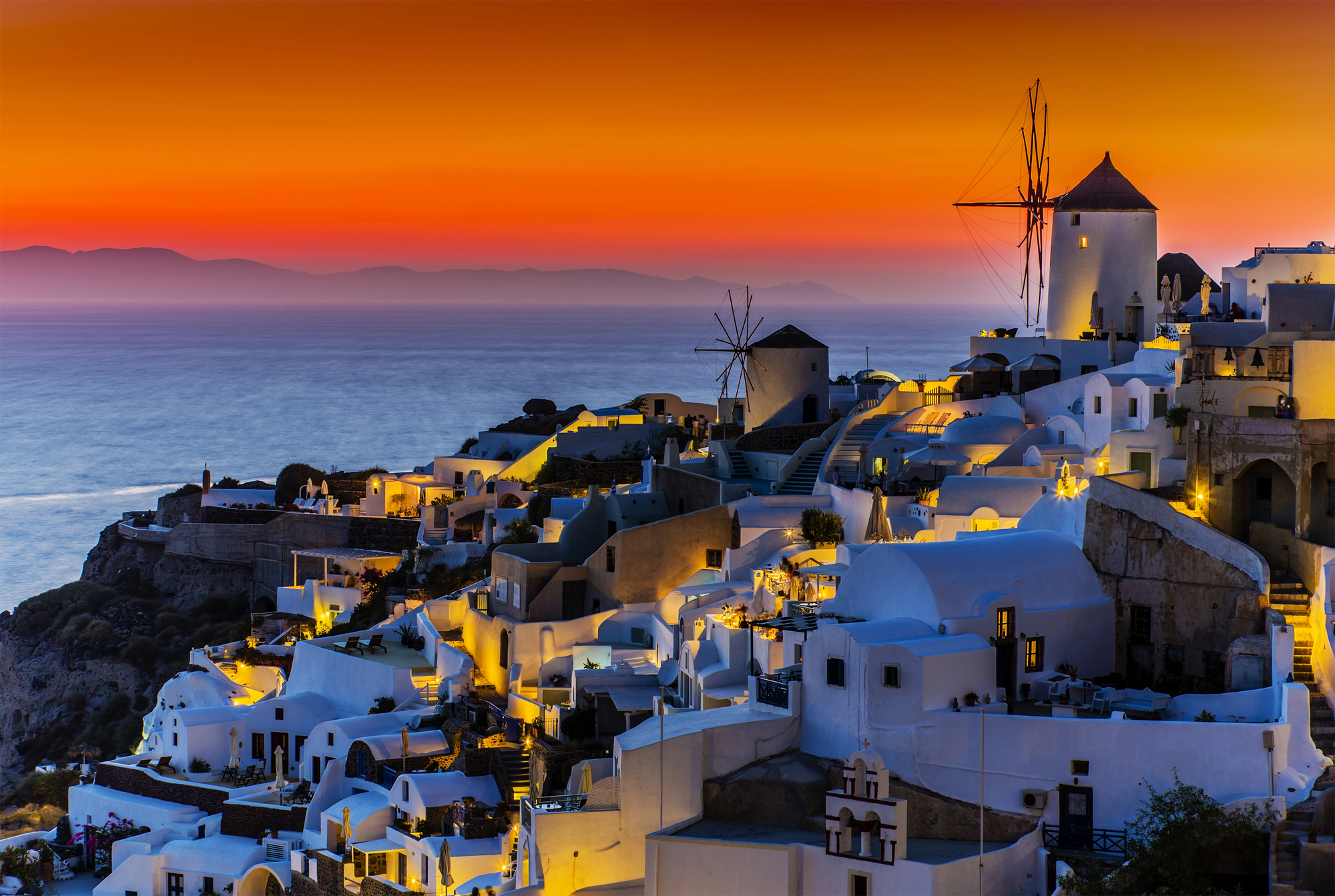
There is a reason Santorini has lived at the top of every bucket list for thirty years. The caldera is one of the most dramatic landscapes on earth. Standing at the rim of a volcanic crater with the Aegean spread out six hundred feet below you, watching the sky turn every shade of orange and rose and deep violet, is an experience that does not require translation across generations.
Your grandmother will gasp. Your teenager will reach for her camera. And your seven-year-old will not say a single word, which is how you will know it worked.
The volcanic beaches are unlike anything else in Greece. Black sand that holds the warmth of the sun long after the light fades. Red cliffs rising from the water. Boat tours into the caldera where you swim in natural hot springs that smell faintly of sulfur and feel like a warm bath drawn by the island itself.
The food and wine culture in Santorini is world-class. Local Assyrtiko wine is crisp and mineral. It pairs perfectly with grilled octopus eaten on a terrace above the sea. The island’s cherry tomatoes, white eggplant, and capers are ingredients you will not find grown this way anywhere else in the world.
What Every Generation Finds to Love in Santorini
Grandparents who appreciate beauty, history, and cuisine thrive in Santorini. The island’s prehistoric settlement at Akrotiri, often called the Pompeii of the Aegean, is one of the most remarkable archaeological sites in all of Greece. It is well-covered and largely flat inside. This makes it accessible for most older travelers who move carefully and at their own pace.
Teenagers respond to Santorini in a way they rarely respond to any destination. The visual drama of the island is genuinely extraordinary for social media. But more than that, the boat tours, the cliff jumping spots, the snorkeling in the caldera, and the sheer otherworldliness of the landscape tap into something real. This is not a manufactured theme park. It is a place that feels like it should not exist, and teenagers recognize that.
Adults, particularly those who love wine, food, architecture, and the pleasure of sitting somewhere impossibly beautiful with a cold glass in their hand, find Santorini deeply satisfying.
Is Santorini Good for Multigenerational Families? Here Is the Truth
This is the question that matters most, and the honest answer is: It depends entirely on the physical makeup of your group.
Santorini’s most celebrated villages, Oia and Fira, are built into the rim of a volcanic crater. The architecture is carved from the cliff face. The pathways are narrow. The steps are steep, uneven, and numerous.
A grandmother with a replaced hip may not be able to walk the caldera path. A grandfather who uses a cane will need a plan before he steps off the cable car. A toddler in a stroller is going to face an island that was not designed with wheels in mind.
The cable car connects Fira to the port below. It is genuinely useful for anyone who cannot manage the 588 steps that zigzag down the cliff face. But even within the village itself, the terrain is uneven and often steep. Mobility matters here in a way it does not on other islands.
How to Make Santorini Work for a Mixed-Age Group
The key to Santorini, with a multigenerational group, is honest advance planning. You need to resist the urge to book accommodation in the caldera villages if your group includes anyone with significant mobility limitations.
Staying in Imerovigli or Firostefani rather than Oia puts you on the caldera rim with access to the views. Plus, it slightly reduces the most challenging terrain.
Staying in Kamari or Perissa on the eastern side of the island gives you flat black sand beaches, easy access for everyone, and a ferry or car ride to the caldera scenery.
The best multigenerational use of Santorini is often as a two- or three-night addition to a longer Greek itinerary rather than a seven-night base. You come, you see the caldera at sunset, you take the boat tour, you eat the tomato fritters at a table over the sea, and then you move to an island that carries the whole group more comfortably for the rest of the trip.
The best Greek island for multigenerational family travel is not always the most famous one, and Santorini is the clearest example of that truth.
Is Santorini good for multigenerational families with grandparents who are active and mobile, teenagers, and adults? Absolutely.
Is it the right base island for a ten-night trip that includes grandparents with limited mobility or children under five? Probably not.
That distinction is not a criticism of Santorini. It is simply the geography telling you the truth.
Rhodes: The Greek Island That Was Built for Every Generation in the Room
If Santorini is a painting you want to stand in front of, Rhodes is a world you want to live inside. And that difference matters enormously when you are traveling with multiple generations who need different things from the same destination.
When families ask which Greek island was actually built for every generation in the room, the answer that holds up to the closest scrutiny is Rhodes. Ask a multigenerational travel specialist which is the best Greek island for multigenerational family travel and Rhodes comes up first, every time. This Greek Island is for groups that need diversity, accessibility, and genuine historical depth under one island roof.
Rhodes has been occupied and shaped by Phoenicians, Greeks, Romans, Crusaders, Ottomans, and Italians. Every one of those civilizations left something behind. The result is an island of extraordinary historical depth layered over some of the finest beaches in Greece. This island is served by an infrastructure that genuinely accommodates large family groups without requiring anyone to sacrifice comfort.
Rhodes Medieval Old Town and Why It Captivates Every Age
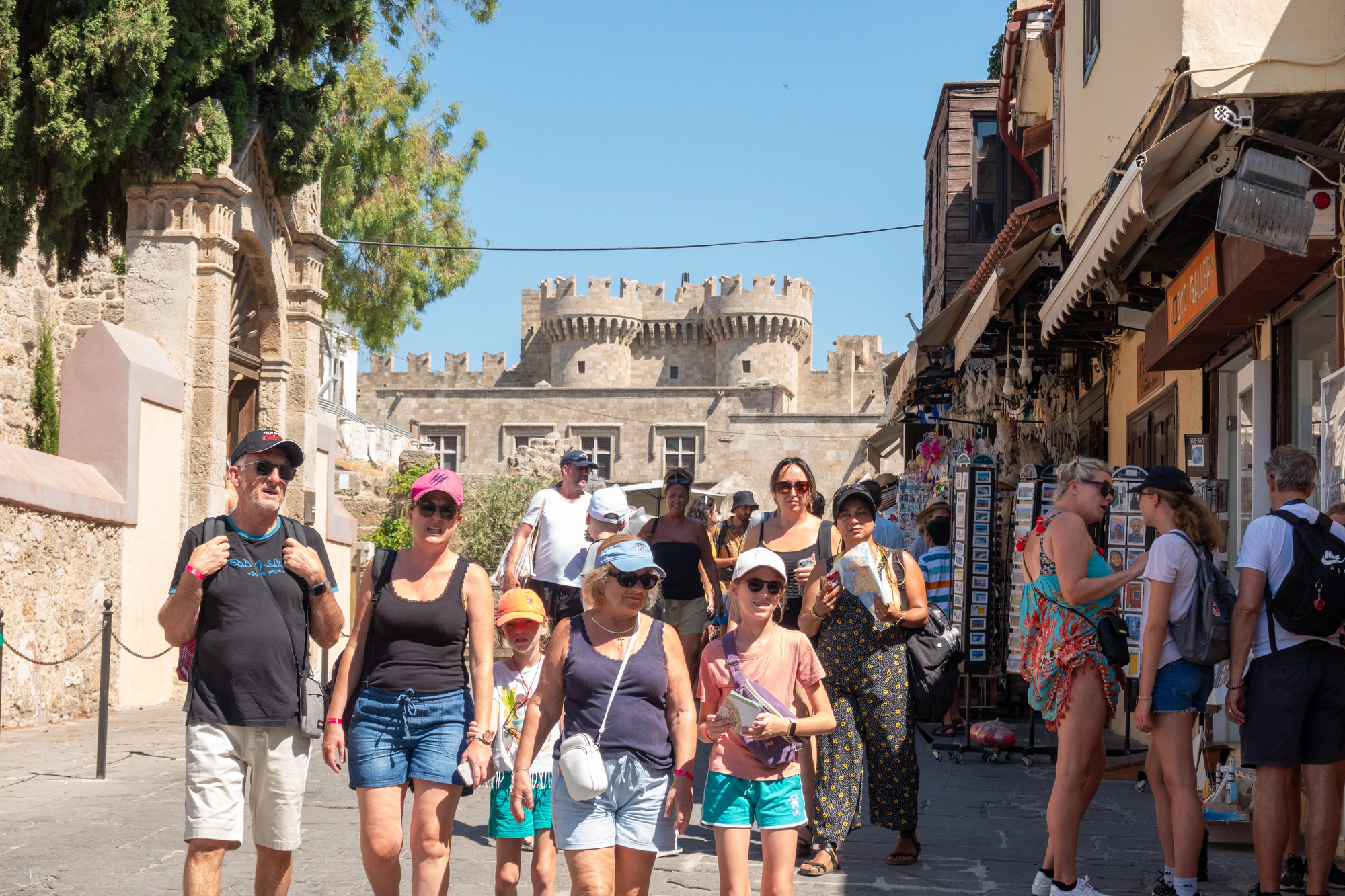
Rhodes medieval old town family travel is one of the most genuinely rewarding multigenerational experiences in all of Europe. The walled medieval city is a UNESCO World Heritage Site. It is one of the best-preserved medieval towns on earth.
Walking through the Gate of Saint John into the old city is the closest most families will ever come to stepping directly into another century.
The Street of the Knights, the Grand Master’s Palace, the mosques and minarets from the Ottoman period, the Byzantine churches, and the busy market streets that have been selling things since the fifteenth century exist side by side inside walls that have stood for seven hundred years.
Your father who reads history will be moved. Your ten-year-old who just finished a unit on castles will be absolutely riveted. And your teenager who claims to find everything boring will stop walking and stare.
What Each Generation Discovers Inside the Old City
Grandparents tend to move slowly through Rhodes Old Town. They find that the pace suits them perfectly. There are cafe tables tucked into every archway. There are shaded courtyards where you can sit with a coffee while the younger members of the group explore further. The history is layered and rich and does not require a tour guide to feel compelling. It speaks for itself.
Children discover that a medieval walled city is one of the most genuinely exciting places they have ever been. The walls are walkable. The towers are real. And the cobblestones and narrow alleys and unexpected courtyards feel like a game invented just for them.
Adults find the old town to be one of those rare destinations where you want to simply wander without a plan and see what the next corner holds. The restaurants inside the walls serve some of the best food on the island. The wine shops, the ceramic studios, the jewelers, and the booksellers that line the lanes make an afternoon disappear without effort.
Beaches, Water Sports, and Wide-Open Space for All Ages
Beyond the old city walls, Rhodes opens into something altogether different. The island’s beaches are long, sandy, and remarkably flat. This makes them genuinely accessible for grandparents, parents, toddlers, and teenagers in the same afternoon without anyone feeling like they compromised.
Faliraki Bay is one of the most well-equipped beach destinations in the Aegean. There is calm water, organized facilities, and water sports that range from gentle paddleboarding to full parasailing.
Lindos Bay curves beneath the ancient acropolis in a scene so photogenic it feels staged. The water stays brilliantly clear and calm enough for young swimmers.
The beaches on the western coast tend to have stronger winds, making them excellent for wind sports, while the calmer eastern shores suit families with younger children.
For teenagers, Rhodes offers the combination of genuine adventure and genuine history that is difficult to manufacture anywhere else. A morning at an ancient acropolis followed by an afternoon of jet skiing is not a contradiction on Rhodes. It is a Tuesday.
Why Rhodes Earns the Title of Best Greek Island for Mixed Ages
Rhodes consistently earns recognition as the best Greek island for mixed ages because it is the only island of the three that requires no trade-off. You do not have to choose between history and beach. You do not have to choose between accessibility and beauty. And you do not have to ask the grandparents to wait while the teenagers do something physical or ask the teenagers to slow down while the grandparents rest.
The island is large enough to absorb a group of twelve without feeling crowded. It is flat enough in the coastal areas to be genuinely navigable for older travelers. It is rich enough in both culture and outdoor activity to keep every generation genuinely engaged for seven to ten days without repeating an experience.
Why Rhodes Works Logistically for Large Multigenerational Groups
Logistics are where multigenerational trips quietly succeed or fail. This is where Rhodes separates itself from the conversation in a very practical way.
Rhodes has a well-developed road system, reliable taxi infrastructure, and wide coastal roads that accommodate group transfers without the white-knuckle bus rides that narrow mountain roads on other islands can produce. The island has a strong inventory of large villas and family resort properties designed to house multiple generations under one roof with separate spaces for privacy and shared spaces for gathering.
The airport receives direct international flights from major European cities and connects through Athens for North American travelers. The port services both day trips to nearby islands and longer Dodecanese ferry routes if your group wants to add an island to the itinerary.
For a family reunion, a milestone birthday celebration, or any occasion that brings three or four generations together around a single table, Rhodes provides the infrastructure to make it feel effortless rather than orchestrated.
Corfu: The Green Island That Moves at the Pace of Your Whole Family
Corfu is the island that surprises people. It does not look like the Greece most people picture when they close their eyes. There are no whitewashed cubic houses tumbling down a volcanic hillside. There are no black sand beaches or caldera views.
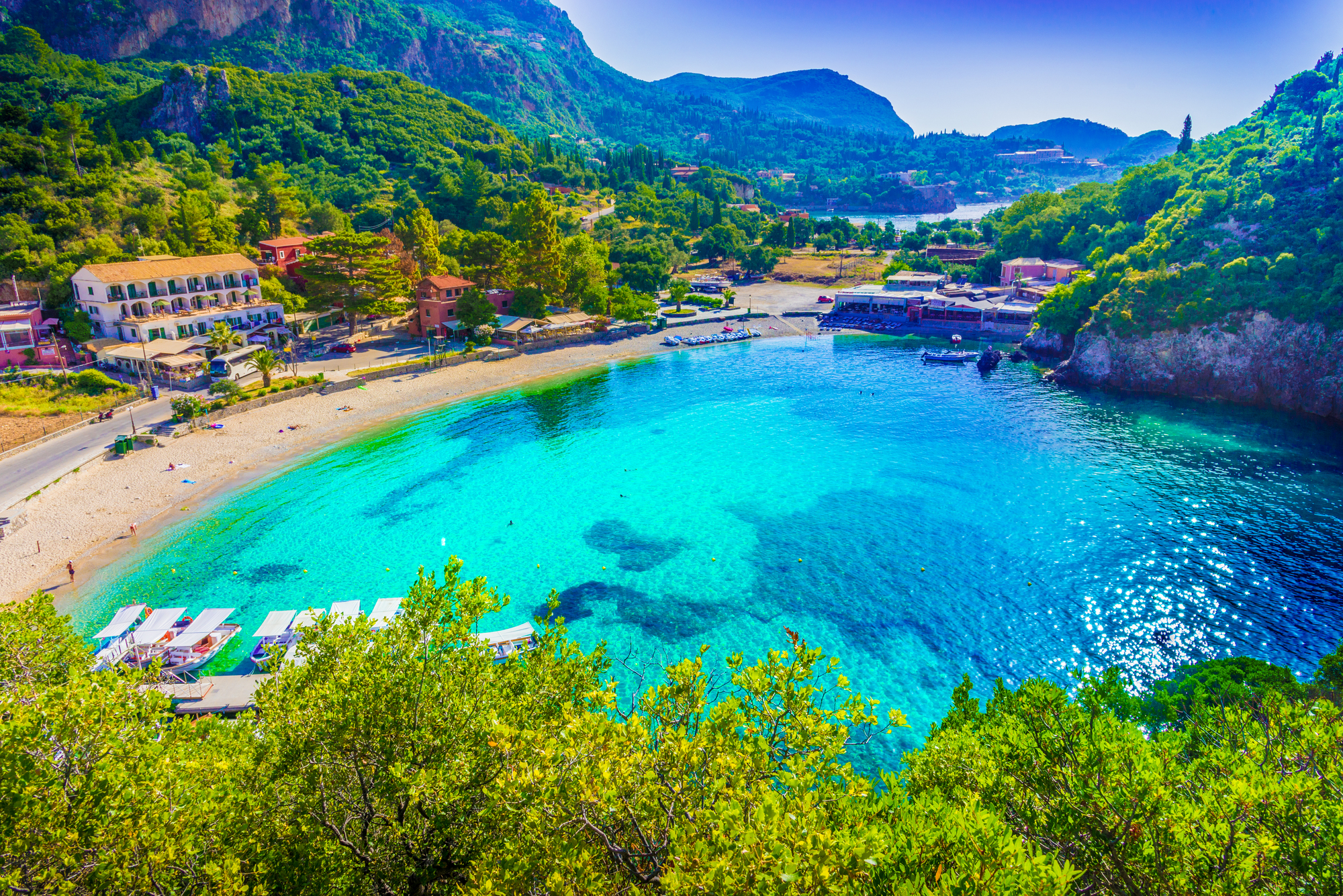
What Corfu offers instead is an altogether different and quietly extraordinary kind of beauty: Rolling hills covered in ancient olive trees. Cypress spires rising above Venetian bell towers. Bays so green and clear they look borrowed from the Caribbean. A pace of life that feels like the island itself is telling you to breathe.
Sitting just off the northwestern coast of Greece near the Albanian border, Corfu has been shaped by Venetian, French, and British rule over the centuries. That layered history gives it a culture and an architecture that feel uniquely Mediterranean without being definitively Greek.
The old town of Corfu, a UNESCO World Heritage Site, reads like Venice without the crowds and the canals. The pastel facades, narrow shaded lanes called kantounia, French-built arcade along the Liston, and twin Venetian fortresses bookending the old town create a setting that feels like it was designed to be wandered at a slow pace with no particular destination in mind.
The Landscape and Culture That Make Corfu Feel Like a Different World
For families asking what the best Greek island for multigenerational family travel looks like when the priority is natural beauty, gentle pace, and a culture that genuinely welcomes every age, Corfu delivers an answer that is quietly overwhelming.
The interior of the island is still largely undeveloped. Olive groves that have been producing oil for centuries shade the roads between villages. The smell of wild herbs and salt air arrives through the car window long before you can see the sea.
The northwestern coastline around Paleokastritsa is considered by many travel writers to be among the most beautiful coastal scenery in the Mediterranean. Turquoise water folded between limestone headlands. Small caves are accessible only by boat. And monastery gardens perched above the sea create a landscape that grandparents call breathtaking and teenagers call actually unreal.
Evening meals in Corfu’s villages are a pleasure. Long tables set outside under a pergola. Local wine poured without ceremony. Grilled fresh fish and plates of slow-cooked stifado arriving as they are ready rather than all at once.
Nobody rushes you. The night is long. That rhythm is exactly what a multigenerational group needs.
Corfu’s Accessibility and Gentle Pace Make It a Multigenerational Dream
Corfu is one of the most accessible Greek islands for grandparents. That accessibility is not incidental. It is structural. The coastal areas are largely flat. The beaches in the north and northeast of the island tend to be gently shelving, with calm Ionian water that warms early in the season and stays warm late.
There are no dramatic caldera stairs to negotiate. No steep volcanic paths. No terrain that requires a grandparent to assess whether their knees can manage it today.
The island’s resort infrastructure, particularly in the north around Dassia and Gouvia and in the northeast around Kassiopi, is well developed for families traveling with elderly parents. Large villas with private pools, ground-floor bedrooms, and easy access to the water are available throughout the island.
The road system is manageable. Local drivers familiar with the island’s lanes make getting around with a mixed-ability group genuinely straightforward.
Grandparents who love architecture, gardens, and history find Corfu Town endlessly rewarding. The Achilleion Palace, built by Empress Elisabeth of Austria and later owned by Kaiser Wilhelm II, sits in gardens above the sea and offers one of the most elegant afternoon outings available anywhere in Greece. The Museum of Asian Art, housed in the former royal palace, is a world-class collection in a world-class setting.
What Teenagers and Young Children Find to Love in Corfu
A family-friendly Greek islands comparison that dismisses Corfu as a destination primarily for older travelers is missing the full picture. The island offers a genuinely impressive range of active experiences that teenagers respond to strongly.
Boat trips along the northwestern coastline lead to sea caves and hidden beaches accessible only from the water. The Blue Lagoon near Erikousa is the kind of place that produces photographs teenagers actually want their friends to see. Water skiing, paddleboarding, kayaking, and scuba diving are all available across the island’s resort beaches.
The Venetian fortresses, particularly the Old Fortress on its sea-surrounded promontory, give older children and teenagers a genuinely impressive piece of history to explore. There is something satisfying about walking the walls of a fortress that Venetian soldiers walked four hundred years ago. Especially when you can see the Ionian Sea spread out in every direction.
For young children, Corfu’s beaches are close to ideal. The shallow, calm water of the Ionian means that small swimmers are not fighting surf or strong currents. The sand beaches in the north of the island are gentle and wide. The local culture is genuinely warm toward children in a way that feels unrehearsed. A toddler demanding attention at a restaurant table will be met with smiles rather than impatience.
Santorini vs Rhodes vs Corfu for Families: A Side-by-Side Look at What Matters Most
This family-friendly Greek islands comparison is designed to answer the exact question many people like you are asking: What are the actual differences between these three islands for a group traveling across generations? The question of which is the best Greek island for multigenerational family travel comes down to four concrete categories.
Terrain and Accessibility Across Three Generations
Santorini is the most challenging of the three for grandparents with any mobility limitation. The caldera villages are built on cliff faces. The terrain is steep, uneven, and often narrow.
Grandparents who are active and in good health will find it manageable and extraordinary. Those with joint pain, balance concerns, or limited stamina should approach Santorini as a short add-on rather than a primary base.
Rhodes is predominantly flat in its coastal and resort areas. The medieval old town has cobblestones that require careful footing, but the terrain is not steep. Wide flat beaches and well-maintained resort infrastructure make Rhodes one of the most accessible options in the Dodecanese for travelers of all ages and physical conditions.
Corfu’s coastal areas are gentle and largely flat. The interior has hills and winding roads. But the places where multigenerational groups spend most of their time, the beaches, the old town, the resort areas, are fully navigable for grandparents, young children, and everyone in between.
Beach Experience and Water Safety for All Ages
Santorini’s volcanic beaches are dramatic and memorable. The black and red sand gets very hot underfoot in midsummer. The sand requires water shoes for young children and careful footing for older travelers. The water is deep relatively quickly, which requires supervision for young swimmers.
Rhodes offers some of the finest sandy beaches in the Aegean. The eastern coastline beaches are calm and ideal for families with young children. The water is warm, clear, and gets deeper gradually. This makes it safe and enjoyable for toddlers and grandparents wading in the shallows.
Corfu’s Ionian beaches are the warmest and calmest of the three. The Ionian Sea is generally calmer than the Aegean. This makes it particularly well-suited for families with very young children or grandparents who want to swim without negotiating waves.
Unforgettable experiences for every traveler during a family vacation in Greece.
Cultural and Historical Depth for the Curious Minds in Your Group
All three islands offer genuine historical richness, but they deliver it differently. Santorini offers prehistoric archaeology at Akrotiri and the island’s own volcanic geological history. Rhodes delivers seven centuries of medieval Crusader history alongside ancient Greek ruins at Lindos. Corfu presents a layered European colonial history through Venetian, French, and British architecture that is unlike anything else in Greece.
The best Greek island for multigenerational family travel in terms of historical variety is Rhodes. It offers the broadest range of historical periods and the most visually dramatic presentation of that history for visitors of every age.
Logistics, Villa Space, and Group Infrastructure
Rhodes wins this category clearly. The island has the largest inventory of multi-generational villas, the most developed resort infrastructure, the broadest range of dining suitable for mixed tastes across ages, and the most reliable transportation network for large groups.
Corfu is a strong second, particularly for groups that prioritize privacy and natural beauty over resort amenities. The villa market in Corfu is excellent. The northern and northeastern coasts have well-developed family resort options.
Santorini, while it has extraordinary luxury accommodation, is the most challenging for large multigenerational groups from a pure logistics standpoint. The terrain makes moving a large group of mixed abilities through the island genuinely complicated.
Which Greek Island Is Best for All Ages for Your Specific Group
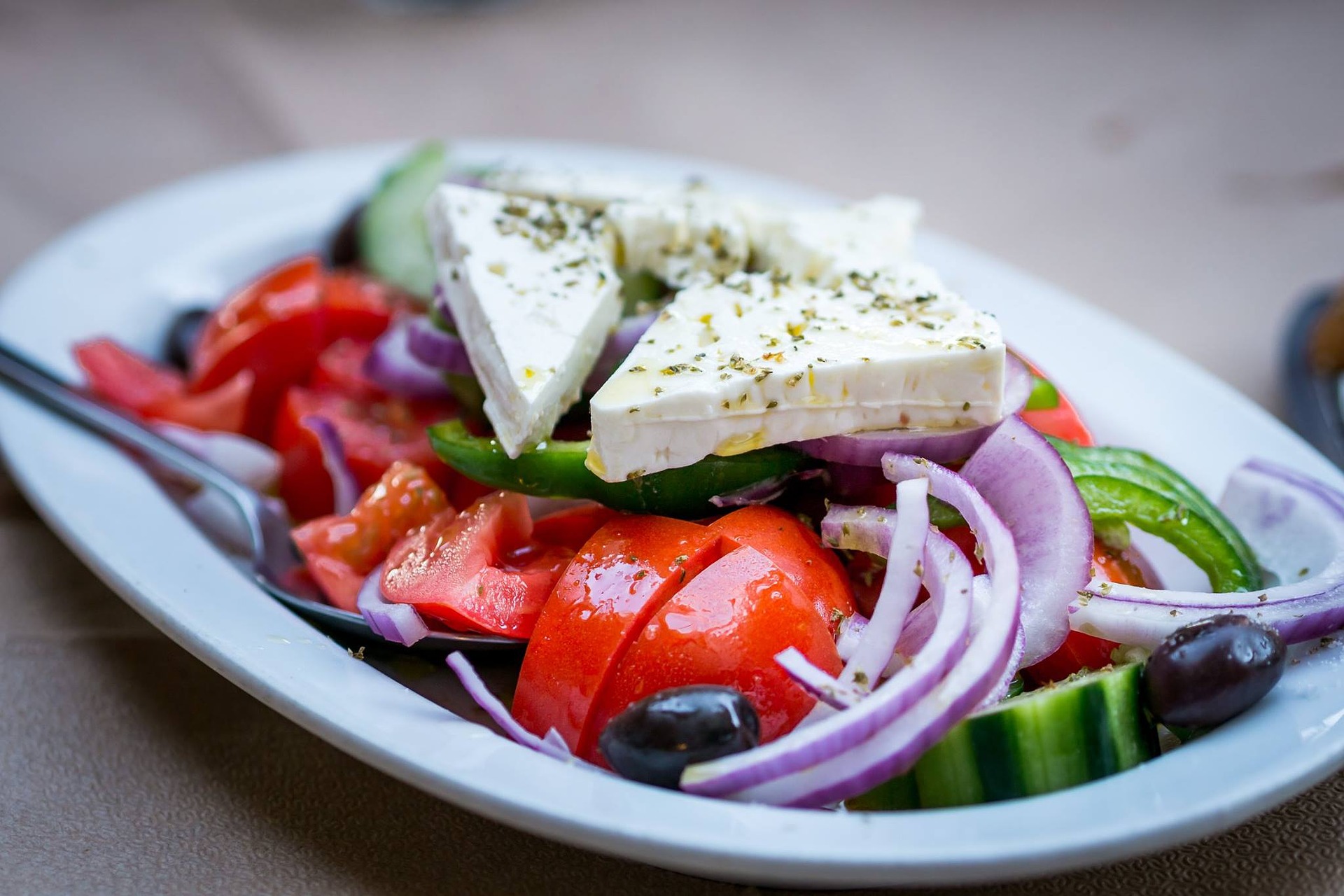
The right answer to which Greek island is best for all ages depends entirely on who is sitting around your specific table. Understanding which is the best Greek island for multigenerational family travel for your group means being honest about four variables:
- Mobility range
- Variety of ages
- Activity priorities
- How much historical depth matters to the adults in the room
If your group includes grandparents with any mobility limitations, Corfu or Rhodes is your answer. Both islands offer genuine beauty, genuine culture, and the infrastructure to move a mixed-ability group through the experience without anyone sitting out. Corfu is the gentler, quieter choice. Rhodes is the richer historical choice with more activity diversity.
If your group spans toddlers, school-age children, teenagers, and grandparents in good health, Rhodes is your answer. It is the only island of the three that requires no trade-off between generations. Every age group finds something that feels designed specifically for them. Plus, the island is large enough and diverse enough to sustain seven to ten days of genuine variety.
If your group is adult children traveling with parents, meaning your multigenerational group skips the youngest generation entirely, all three islands deserve serious consideration. Santorini becomes much more accessible when strollers and young children are not part of the equation. A group of adults in their thirties, forties, and sixties can move through Santorini’s caldera villages with pleasure rather than logistics anxiety.
If you want a combination trip, the pairing that serves multigenerational groups best is Rhodes as the primary base of seven to eight nights, with two to three nights in Santorini added for the caldera experience. This gives your group the accessibility and diversity of Rhodes for the majority of the trip. Plus, the irreplaceable visual drama of Santorini for a shorter, more intentional experience.
The One Mistake Most Multigenerational Families Make When Choosing a Greek Island
The one mistake most families make is choosing based on the photograph rather than the group. They book Santorini because the caldera photograph is the one that lives in their imagination. They do not ask until they arrive whether their mother can manage the stairs or whether the stroller fits through the gate.
The right island is not the most beautiful island in the abstract. It is the island that is most beautiful for the specific people you love most.
How I Plan a Luxury Multigenerational Trip to Greece So You Never Have To
Luxury multigenerational travel in Greece is not simply a matter of booking the most expensive villas on the nicest island. It is a matter of understanding that the best Greek island for multigenerational family travel is determined by the people in your group, not the photographs in a travel magazine.
A grandmother who cannot access the beach because the path is too steep is not experiencing luxury, regardless of the thread count on her sheets.
What a Luxury Multigenerational Vacation in Greece Should Look Like
Real luxury for a multigenerational group means that every single person, from the youngest to the oldest, can participate fully in every day without anyone feeling like a burden or a limitation on the group.
That is what a fully planned multigenerational family vacation in Greece looks like when someone else is holding every detail.
It looks like a villa selected not just for its infinity pool view but for its ground-floor bedroom suite and its flat access to the water.
It looks like a private boat chartered for the afternoon, so your grandmother does not have to negotiate the steps down to the harbor. And it looks like a table reserved at the right restaurant, on the right terrace, at the right hour, so the sunset lands exactly where it should be when the wine is poured.
It looks like none of you having to research any of that. It looks like you arriving and simply being present for the people you love, because someone who has been to all three islands, who knows the difference between a villa with cobblestone access and one with a flat drive, who knows which beach has the calmest water for your five-year-old and which archaeological site has the right guide to keep your teenager engaged, has already handled it.
The best Greek island for multigenerational family travel is not the same island for every family. But the process of finding your right island, planning your right itinerary, and making sure that every generation leaves Greece with a full heart and a story they will tell for years, that process does not have to fall on your shoulders.
That is what I do.
There is a moment on every multigenerational trip to Greece when the planning disappears completely. It usually happens at dinner. The table is long and the candles are lit and someone has ordered too much food and the wine is cold and the kids are laughing about something that happened on the boat that afternoon and your mother is telling a story you have heard before but somehow it sounds different here, with the sea behind her and the stars coming out above the whitewashed rooftop across the lane.
Nobody checks their phone.
That moment does not happen by accident. It happens because the right island was chosen for the right reasons. And because someone who understood what your family needed made sure every detail served that single purpose: Giving all of you the space to finally be together, completely, without anything left to manage.
The best Greek island for multigenerational family travel is the one where that moment finds you. Let me help you find the island where it will.
The truth about group travel planning and why it falls apart without a travel advisor.
So, are you ready to start planning your multigenerational family vacation to the Greek Island that is best for your group?
If you said yes, I would like to invite you to click here to schedule a personalized planning session with me. Clicking the link will take you directly to my digital calendar to schedule a time that is convenient for you.
Not ready to start planning a vacation to Greece just yet? Sign up for my newsletter and continue to receive all the travel information I share.

Tracy is the owner of Elite Travel Journeys, a luxury travel agency dedicated to crafting extraordinary, memory-making journeys for families, multigenerational groups, empty nesters, and solo female travelers. A proud military veteran and President of the Central PA Chapter of ASTA, Tracy brings both discipline and deep passion to everything she does. With a particular love for river cruising, especially Europe’s enchanting Christmas Markets, she has been turning travel dreams into life-changing experiences since 2014. Tracy believes that extraordinary travel doesn’t just take you somewhere new; it changes who you are.
Enter your Name and best Email Address to receive
On Your Next Family Vacation
We respect your privacy and will never share or sell your information.
3 Ways to See It All in Alaska


On Your Next Family Vacation
Click here for 10 Exciting Family Adventures
You Can Plan
NOW