
The Tango Experience in Buenos Aires That Will Change the Way You Travel
The tango experience in Buenos Aires is not something you watch from a safe distance and politely applaud. It pulls you in, chest to chest, breath to breath, and rearranges something inside you that was never quite the same afterward. This is not a dance lesson. This is a reckoning with yourself, with the city, and with the kind of traveler you are still becoming.
Buenos Aires does not offer tango as a souvenir. It offers it as an invitation. And the women who say yes to that invitation, the ones who have spent years managing everything and everyone, almost always say the same thing when they come home: That was the trip that reminded me I am still someone worth discovering.
The Tango Experience in Buenos Aires That Will Change the Way You Travel
What Is the Tango Experience in Buenos Aires?

Most people arrive in Buenos Aires thinking they know what tango is. They picture sequined dresses, theatrical leg kicks, and roses clenched between teeth. What they find instead is something far more interesting.
Tango is a conversation. It is two people listening to each other through movement, negotiating trust and surrender in real time. Tango was born in the working-class neighborhoods of Buenos Aires in the late 19th century. It carries in its music the grief of immigrants who crossed an ocean and the resilience of people who refused to stop living. In 2009, UNESCO recognized tango as an Intangible Cultural Heritage of Humanity. Not because of its footwork, but because of what it means to the human spirit.
The authentic tango Buenos Aires offers has nothing to do with performance and everything to do with presence. It is not something you see. It is something you inhabit.
Check out other cultural immersion experiences for empty nester vacations.
The Styles of Argentine Tango: More Than One Language
Argentine tango is not a single dance. It is a family of related forms, each with its own personality, rhythm, and emotional register. Understanding the different styles helps you find the one that speaks to you before you ever set foot on the floor.
The Classic Forms
Tango Salon
Tango Salon is the style most visitors encounter first. Elegant, precise, and deeply connected. It is the form danced at the milongas, the traditional social gatherings where local dancers fill a ballroom and move together in a kind of organized improvisation. This is the heartbeat of the authentic tango that the Buenos Aires community keeps alive every single night.
Milonguero Style
Milonguero Style takes the connection even deeper. The embrace is close, almost still, and the footwork stays small. What it lacks in spectacle is more than compensates for in intimacy. If you want to understand why tango changed the world, spend an evening learning the Milonguero style.
Tango Canyengue
Tango Canyengue is the oldest form still danced today. Its posture is bent slightly forward, its rhythm syncopated and playful. Dancing Canyengue feels like stepping into a black-and-white film from the 1920s.
Tango Orillero
Tango Orillero developed in the outskirts of Buenos Aires, where dancers had more room to play. It is expressive, acrobatic, and full of personality.
The Contemporary Forms
Tango Nuevo
Tango Nuevo is the style that provoked a revolution. This style was choreographed by a new generation of dancers in the 1990s. It opened the traditional embrace, introduced new rhythms, and invited the dance into conversation with contemporary music. It is technically demanding and visually stunning.
Tango Con Corte y Quebrada

Tango Con Corte y Quebrada preserves the street-level swagger of early Buenos Aires. Its sharp breaks and hip movements carry the DNA of tango before it was ever considered elegant.
Show Tango and Tango de Fantasia
Show Tango and Tango de Fantasia are the theatrical forms built for performance. High kicks, dramatic dips, lifts that seem to defy physics. This is the tango of stages and spotlights. And when executed by world-class dancers, it is absolutely breathtaking.
Tango Tradicional
Tango Tradicional is exactly what it sounds like: The pure, unadorned, deeply serious form that true aficionados spend lifetimes perfecting.
How to Learn Tango in Buenos Aires: Where to Begin
Here is the question every traveler eventually asks: Can a complete beginner actually learn tango in Buenos Aires? The answer is yes, and the experience of learning it there, in the city where it was born, is incomparably different from any class you might take at home.
The best time to visit Buenos Aires for tango is between March and November. This is when the weather is mild and the milonga calendar is full. The World Tango Championship draws competitors and spectators to the city each August. This makes that month particularly electric if you want to immerse yourself in the Buenos Aires tango cultural experience at its most celebratory.
Tango Lessons Buenos Aires for Beginners: What to Expect
If you are new to tango, tango lessons in Buenos Aires for beginners typically start with a single principle: Connection before steps. A good instructor will spend the first twenty minutes teaching you how to stand, how to breathe, and how to listen to another person through your frame before a single step is taken.
This is not a beginner disappointment. It is the entire point. Tango is not choreography you memorize. It is a language you learn to speak in the moment, which means the fundamentals matter more than anything.
A private lesson with a skilled Buenos Aires instructor typically runs sixty to ninety minutes. Many travelers book two or three lessons on consecutive days and find that the progress between the first and third session is startling.
The city itself is your practice room: The music comes from every corner of San Telmo and Palermo. And the rhythm finds you whether you are looking for it or not.
La Viruta: The Dance Hall That Never Sleeps
La Viruta is one of the most beloved dance halls in Buenos Aires. It is tucked into the Palermo neighborhood that feels like an endless Saturday evening. What makes La Viruta a perfect starting point for travelers is its accessibility.
There are no reservations required. This means a spontaneous decision on a Buenos Aires night can lead you through its doors without any planning at all. Classes run at multiple levels. So, a traveler who has never touched a dance floor in her life will not be grouped with competitors. She will be exactly where she belongs: In a room full of people who are figuring it out together, in one of the most beautiful cities in the world.
Escuela Mariposita: The Private Oasis in San Telmo
If the idea of learning with an audience makes you want to skip the lesson entirely, Escuela Mariposita is your answer. Housed inside a preserved old mansion in the San Telmo neighborhood, this school offers private tango lessons in a space that feels more like a literary salon than a dance studio.
The cultural center attached to the building gives the visit an additional layer of depth. After your lesson, you can wander through its rooms and let Buenos Aires teach you something else entirely.
For families or small groups traveling together, the private format here is particularly powerful. There is something about learning tango together, including the laughter when someone misses a step, that becomes one of those shared stories a family tells for years.
DNI Tango: The School Built for Travelers
DNI Tango has earned its reputation as one of the most traveler-friendly schools in the city. Classes are offered at every level and taught in multiple languages. Plus, the school offers free introductory sessions for anyone who wants to test the waters before committing.
This is the place to learn tango in Buenos Aires when you are not entirely sure you are ready, because DNI Tango makes readiness feel irrelevant. You simply show up, and the dance finds you from there.
The Milonga: The Heart of the Authentic Tango Buenos Aires Experience
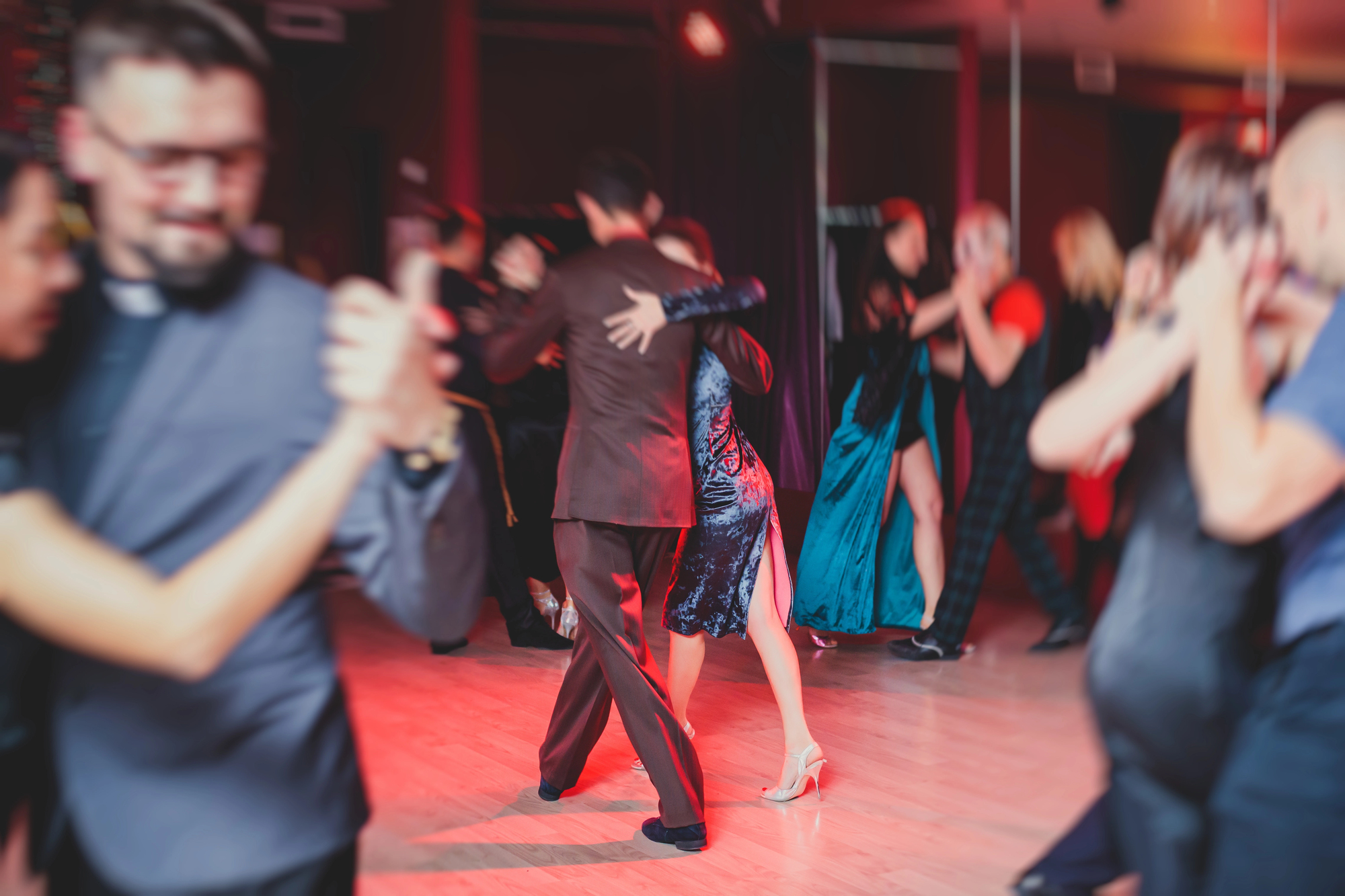
If there is one word you need to understand before you arrive in Buenos Aires, it is this one: Milonga.
Milonga is a social tango gathering. It is not a performance or a class. It is where local dancers come together several nights a week to dance with each other in an atmosphere that is elegant, intimate, and governed by a beautiful set of unspoken codes.
Locals have been gathering at milongas in Buenos Aires every night for over a hundred years. The dance does not stop because tourists arrive. The dancers simply make room.
Milonga Buenos Aires for Tourists: How to Navigate It
A milonga in Buenos Aires for tourists can feel intimidating without context. Etiquette is real and worth understanding before you walk through the door. Dancers use a subtle nod called the cabeceo to invite each other onto the floor. Music is played in sets called tandas, with brief pauses called cortinas between them. The floor moves counterclockwise and collisions are considered serious failures of attention.
None of this should discourage you. It should excite you. You are not walking into a tourist experience. You are walking into a living tradition that has survived a century because it matters deeply to the people who practice it. Going with a guide or attending a lesson beforehand transforms the milonga from an observation into a participation. And participation, even tentative and imperfect, is one of the most meaningful travel experiences Buenos Aires offers.
Where to Watch Tango in Buenos Aires: The Best Performances in the City
Not every evening needs to end in your own arms. Sometimes the best tango experience in Buenos Aires is the one where you simply let yourself be moved by watching it.
Astor Piazzolla Theatre
The Astor Piazzolla Theatre is named for the composer who changed tango forever. He was the man who convinced the world that tango could be concert music without losing its soul.
Performances here are technically astonishing. Competitive and professional dancers share the stage in productions that are precisely choreographed, physically demanding, and emotionally transporting. Performances are held every evening. This makes scheduling easy no matter how full your Buenos Aires itinerary already is.
An Intimate Evening with Live Music
Some of the most memorable tango experiences in the city happen in smaller, more intimate venues where the dancers perform to live musicians and singers rather than recordings. There is a quality to that kind of evening that no large production can replicate.
The music breathes differently when it is being made in the same room. The dancers respond to it in real time. You feel the difference immediately. Even if you cannot yet explain why.
If you want the full experience, go to a dinner and performance together. Let the evening begin over a good Malbec and end on a dance floor you never expected to find yourself standing on.
Cafe Tortoni and the Argentine Tango Museum
Cafe Tortoni is one of the oldest and most storied cafes in Buenos Aires. It is a place that feels like it belongs in a novel about the city rather than in the city itself. But it is also a venue for tango. And the performances held in its historic Alfonsina Storni Room carry the weight of that setting in every moment.
The most popular show, Tango Sensations, runs multiple times a week. The Argentine Tango Museum located directly above the cafe adds an extraordinary layer of context to the evening. Arriving early to walk through that museum before the performance will change the way you watch the dancers. You will understand, in a way that is difficult to articulate, why this dance matters.
The Tango and Wine Buenos Aires Experience: An Evening That Has Everything
Buenos Aires is a city that knows how to build an evening. The tango and wine Buenos Aires experience has become one of the most sought-after ways to spend a night in the city. And for good reason. Combining a beginner tango lesson with an empanada tasting and a guided wine flight introduces you to three of Argentina’s most essential pleasures in a single, unhurried evening.
These experiences often take place inside historic conventillos. Those are the tenement buildings where immigrants lived in the 19th century and where tango was first danced. Standing in those rooms, holding a glass of Argentine Malbec, learning the first steps of a dance that was born in grief and joy in equal measure, is a way of knowing a city that no museum can replicate.
Argentina Tango Travel Beyond Buenos Aires
While Buenos Aires is the unquestioned home of tango, Argentina tango travel can extend beautifully beyond the capital.
The province of Mendoza pairs the soulfulness of tango with the wine country that produces some of South America’s finest reds. Córdoba has a growing tango scene with a younger, more experimental energy.
And for travelers who want to combine tango with the dramatic natural beauty of the country, an Argentina itinerary that moves between Buenos Aires and Patagonia or Iguazu Falls allows the dance to share the stage with some of the most extraordinary landscapes on earth.
The Best Tango Experience in Buenos Aires Starts with a Decision
The best tango experience in Buenos Aires is not determined by your skill level, your rhythm, or how many dance classes you have ever taken. It is determined by your willingness to show up and be present in a way that most of your daily life does not require of you.
Tango asks you to stop planning. It asks you to stop controlling. It asks you to listen, adjust, and respond to another person in real time with no script and no safety net. For the woman who manages everything, who plans every detail, who holds everyone else’s lives together with both hands, that is not a small thing. That is an enormous, quietly radical act of letting go.
The meaningful travel experiences Buenos Aires makes possible are not confined to the dance floor. They live in the walk home after a milonga. In the empanada eaten standing up in San Telmo at midnight. In the Malbec that tasted different after everything else that happened that evening.
Buenos Aires has a way of reaching into the places you forgot to protect and leaving something behind. Tango is just the key it uses to get in.
The Tango Experience in Buenos Aires: Your Questions Answered
What is the difference between a tango show and a milonga in Buenos Aires?
A tango show is a ticketed performance where professional dancers entertain an audience. A milonga is a social gathering where everyone, including visitors, is invited to dance alongside locals. Shows offer spectacle. Milongas offer participation and cultural immersion.
Can a complete beginner attend a milonga in Buenos Aires?
Yes. Attending with guidance, either a local escort or after taking a lesson that afternoon, makes the milonga accessible and genuinely enjoyable for beginners. You do not need to dance. You can observe, absorb, and feel the room. Many first-time visitors find that simply being present at a milonga is one of the most memorable nights of their traveling life.
What should I wear to a tango experience in Buenos Aires?
For a milonga or dinner show, smart casual is appropriate. Leave the athleisure at the hotel. A beautiful blouse, tailored trousers or a dress, and comfortable shoes that allow movement are ideal. If you plan to dance, prioritize shoes you can actually move in over shoes that only look good standing still.
Is Buenos Aires safe for solo female travelers?
Buenos Aires is one of the most visited cities in South America. It is generally safe for solo female travelers who apply the same awareness they would in any major city. The tango community itself is notably welcoming to women traveling alone. Solo female travel in Buenos Aires has become a genuine draw for women who want a city that is sophisticated, walkable, and full of culture.
What is the best time to visit Buenos Aires for tango?
March through November offers the most comfortable weather and the fullest milonga calendar. August brings the World Tango Championship, which draws the world’s finest dancers to the city and creates an atmosphere that is difficult to describe and impossible to forget.
Check out the best destinations to visit in Argentina during a winter vacation.
So, are you ready to take a family vacation in Argentina and learn how to tango?
If you said yes, I would like to invite you to schedule a planning session with me by clicking here. Clicking the link will take you directly to my digital calendar to schedule a time that is convenient for you.
And if you are not ready to tango during a family vacation in Argentina, you can sign up for my newsletter here. This will ensure you always receive all the travel information I share.

Tracy is the owner of Elite Travel Journeys, a luxury travel agency dedicated to crafting extraordinary, memory-making journeys for families, multigenerational groups, empty nesters, and solo female travelers. A proud military veteran and President of the Central PA Chapter of ASTA, Tracy brings both discipline and deep passion to everything she does. With a particular love for river cruising, especially Europe’s enchanting Christmas Markets, she has been turning travel dreams into life-changing experiences since 2014. Tracy believes that extraordinary travel doesn’t just take you somewhere new; it changes who you are.
Enter your Name and best Email Address to receive
On Your Next Family Vacation
We respect your privacy and will never share or sell your information.
3 Ways to See It All in Alaska


On Your Next Family Vacation
Click here for 10 Exciting Family Adventures
You Can Plan
NOW