
Your Kids Can Swim Through Ancient History: The Best Sunken Cities to Visit on a Family Vacation
The sunken cities you can visit with your family are some of the most extraordinary places on earth. And most parents have no idea they even exist. While other families are retracing the same theme park loops for the third summer in a row, a small number of extraordinarily curious families are slipping beneath the surface of the world’s most storied waters. They are floating above streets that have not felt sunlight in thousands of years. Their children are not looking at artifacts behind glass. They are hovering over them, masks pressed to the water, hearts racing, as ancient stone walls drift into focus below.
That is the kind of trip that does not fade. That is the kind of trip your children will describe to their own children someday.
This guide was written for the family that wants more. More wonder. More depth. And more of those rare travel moments that you could not have manufactured on any itinerary you have ever seen. Whether your family snorkels, dives, or simply wants to look down from a glass-bottomed boat, the sunken cities around the world featured in this post offer something that no museum, no monument, and no guided city tour ever could. They offer the feeling of standing at the edge of time itself.
Family snorkeling ancient ruins is one of the fastest-growing categories in luxury family travel. It is not hard to understand why. The experience sits at the intersection of adventure and education, beauty and mystery, and it belongs to no single age group. It is genuinely, expansively extraordinary.
Your Kids Can Swim Through Ancient History: The Best Sunken Cities to Visit on a Family Vacation
The Best Sunken Cities You Can Visit with Your Family
The best sunken cities you can visit with your family combine shallow-enough depths for accessible exploration, rich enough history to captivate curious young minds, and enough above-water activities to make it a full, immersive trip. These eight destinations deliver on every count.
Pavlopetri, Greece: Europe’s Oldest Underwater City

Picture this. Your child adjusts her snorkel mask, drops her face into clear Aegean water, and looks down at the outline of a street. Not a painting of one. Not a reconstruction. An actual street, paved by human hands more than five thousand years ago. And it is still visible in the shallow water off the southern coast of Greece.
Pavlopetri is one of the oldest sunken cities in the world. Plus, it is one of the most accessible for families. The site sits in just ten to twelve feet of water. It is spread across roughly two acres off the coast of the Peloponnese. Researchers have identified approximately fifteen buildings, as well as roads, courtyards, and what appear to be ceremonial spaces. The city is thought to date back at least to 2800 BCE. Although, some researchers believe the site may be even older than that.
Why Pavlopetri Is a Perfect Family Snorkeling Destination
The shallow depth is the defining advantage here. For families snorkeling underwater ruins with children, Pavlopetri is about as ideal as it gets. No scuba certification is required. No dive boat charter is necessary. Families can wade in from the shore and begin exploring within minutes.
The mainland sits close enough that you can build an entire Greece family vacation around this single stretch of coastline. From the ancient ruins of Olympia and the dramatic clifftop villages of the Mani peninsula to long lunches of grilled fish and crusty bread at waterfront tavernas.
Pavlopetri is not just a snorkeling stop. It is the centerpiece of an unforgettable southern Greece itinerary.
What makes multigenerational travel work here is the layering of experience. Grandparents can observe the site from a nearby boat or the shoreline. Parents can snorkel alongside their children. And for older teenagers or young adults with an open-water certification, there is even more to explore. Everyone comes away with a different version of the same astonishing story.
Check out these ancient ruins you can explore around the world without the crowds.
Bimini Road, The Bahamas: The Mystery That Has Never Been Solved
Off the coast of North Bimini in the Bahamas lies a formation of large, flat limestone blocks arranged in a curved, J-shaped path stretching nearly half a mile. It was discovered in 1968. This is when diver Joseph Mason Valentine spotted what appeared to be a paved roadway at the bottom of the shallow seafloor.
Since that moment, debate has never stopped. Some researchers argue the formation is entirely natural, the product of tidal erosion and geological chance. Others point to the precision of the alignment, the presence of nearby artificial-looking ruins, and even the reported discovery of a submerged structure resembling a pyramid near Berry Island. They are not ready to call it coincidence.
The Atlantis Question That Keeps Everyone Talking
For families with children who have already fallen down the rabbit hole of mythology, lost civilization theories, and ancient mysteries, Bimini Road is irresistible.
Could it lead to Atlantis? Researchers have not ruled it out. No definitive conclusion has been reached. And that open question is part of what makes this one of the most compelling lost cities underwater travel experiences in the world.
The Bahamas as a destination adds considerable weight to this choice. The water is warm, clear, and shallow enough for confident family snorkeling. The islands surrounding Bimini offer laid-back luxury, excellent fishing, and beaches so pristine they feel almost fictional.
A family who ventures to North Bimini to explore the road comes back with something no other family in their neighborhood has: A genuine mystery, experienced firsthand, still unsolved.
The Temples Off the Coast of Malta: Ruins That May Rewrite History
Malta already carries an extraordinary weight of history. The island is home to some of the oldest freestanding structures on earth. But the ruins that lie just offshore, discovered in 1999 approximately two to three miles from the coast of St. Julian, may be equally significant.
Believed by some researchers to be the Temples of Gebel Gol-Bahar, these underwater ruins include several structures and a series of cart ruts etched into the submerged rock. Those ruts are particularly important. They suggest that whatever lies below was once above the waterline. A city or ceremonial complex that existed when the Mediterranean was a very different place.
Malta as an Immersive Family History Destination
No official archaeological study has been completed at the site since its discovery. This means the age and origin of these temples remain officially unconfirmed. A handful of researchers have even speculated, as they have with other underwater ruins around the world, that this site could be a remnant of the legendary city of Atlantis. Whether that theory holds weight or not, the site is extraordinary. And the conversation it opens around the dinner table is worth everything.
Above water, Malta is one of the most underrated family destinations in the Mediterranean. The streets of Valletta are a living museum. The limestone cliffs of Gozo offer dramatic scenery. The Blue Lagoon is so achingly beautiful that photographs of it look enhanced.
Visiting the underwater ruins off the coast of Malta as part of a broader Mediterranean family vacation is the definition of immersive travel history with kids.
Dwarka, India: The Lost City of a God

A Mythological City That Turned Out to Be Real
According to Hindu scripture, the god Krishna ruled from a magnificent golden city called Dwarka. A place of unimaginable grandeur that was eventually swallowed by the sea. For centuries, this story was treated as mythology. Then, between 1999 and 2001, the National Institute of Ocean Technology conducted underwater surveys in the Gulf of Khambhat off the coast of Gujarat. They discovered something that no one was fully prepared for: Columns, temples, and stepped buildings, submerged beneath the sea, in the exact region where the sacred texts had always said the lost city stood.
The site at Dwarka is believed by some researchers to be approximately nine thousand years old. Although, official confirmation of the age is still ongoing. What has been confirmed is that this is one of the most historically significant underwater archaeological sites in the world. It is also one of the most spiritually resonant.
For families traveling with grandparents who hold Hindu faith, standing near the ocean at Dwarka while knowing that the ancient city may lie just below the surface is a deeply moving experience.
Planning a Family Visit to Dwarka
Dwarka is not a casual snorkeling stop. Access to the underwater site itself is restricted and managed. This means families will need to plan this as part of a well-organized itinerary.
The city of Dwarka on the Saurashtra coast itself is a major pilgrimage destination and a fascinating place to explore. The Dwarkadhish Temple, dedicated to Krishna, rises above the city in a way that feels eternal. The surrounding region offers a side of India that is far removed from the familiar tourist trails. And that is exactly what makes it extraordinary for the family that wants to go deeper.
This is one of those destinations where a well-connected luxury travel advisor is not a luxury. It is a necessity.
The Temples of Mahabalipuram, India: Where the Sea Gave Back What It Took
Along the Coromandel Coast of Tamil Nadu, the shoreline near the town of Mahabalipuram has been legendary for a very long time. Ancient Tamil literature spoke of a great city with seven pagodas. A place so beautiful and prosperous that the gods themselves grew jealous and sent the sea to swallow it. Locals always believed the story was true. In 2001, they were proven right.
Following the massive 2004 Indian Ocean tsunami, as the retreating water pulled back further than any living person had ever seen, the shoreline at Mahabalipuram revealed ancient walls, fallen pillars, and carved stones that had not been seen in centuries. Archaeological surveys that followed confirmed the presence of substantial submerged structures. They are likely remains of temples and perhaps entire sections of the legendary city described in the old texts.
The Seven Pagodas and What Still Lies Beneath
Researchers believe the walls and pillars discovered here may be part of the mythological Seven Pagodas complex. A sacred site whose existence had been debated for generations.
The Shore Temple that stands on the beach today is a UNESCO World Heritage Site. It is also one of the oldest structural temples in southern India. And it may be the only surviving member of a much larger architectural complex that once defined this coastline.
For families with an interest in Hindu mythology, ancient South Indian history, or archaeological discovery, Mahabalipuram is a profound destination. Children who have grown up on stories of lost cities will recognize immediately that they are standing somewhere that was lost and then found. The experience of walking among the temples on land, then understanding that there is more beneath the waves, gives a child a relationship with history that no classroom can replicate.
As a broader family destination, Tamil Nadu is spectacular. The food is extraordinary. The temples are among the most architecturally detailed in the world. And Mahabalipuram sits on a beautiful stretch of coastline that is warm, welcoming, and far less traveled than it deserves to be.
The Stonehenge-Like Structure of Lake Michigan: America’s Hidden Ancient Mystery
You Do Not Have to Cross an Ocean for Ancient Wonder
Most people do not think of Lake Michigan when they think of kid-friendly underwater archaeological sites. That is exactly what makes this discovery so satisfying.
While scanning the lakebed for shipwrecks, archaeologists discovered a formation of stones arranged in what appears to be a deliberate, Stonehenge-like pattern at the bottom of Lake Michigan. The discovery was largely unannounced at the time. And the precise location has not been widely publicized. This adds another layer of intrigue to a site that already feels like something out of a novel.
This is the kind of discovery that speaks directly to a child’s imagination. An ancient stone arrangement, sitting quietly beneath freshwater, in the middle of America, waiting to be understood.
The Great Lakes region offers exceptional family travel experiences year-round. Cultural institutions, waterfront towns, dune landscapes, and deep maritime history all combine to make this corner of the country far more adventurous than families often expect.
For the family that wants to experience underwater world history travel without a passport, the discovery in Lake Michigan is a conversation starter and a genuine point of wonder.
Fuxian Lake, China: China’s Atlantis
Deep beneath the surface of Fuxian Lake in Yunnan Province, China, divers have discovered something that has generated years of debate and wonder. Divers have pulled thirty buildings and forty handmade stone relics from the silence of the lakebed, and the unusual carvings etched into the stone mirror local legends so precisely that coincidence stopped being a reasonable explanation long ago.
For centuries, the people of this region told stories of a lost city beneath the lake. Researchers have now confirmed that something is genuinely there. Researchers have taken to calling it “China’s Atlantis,” and with good reason. Divers have barely scratched the surface of what lies beneath Fuxian, yet what they have already found places this lake firmly among the most compelling ancient, submerged cities a family can visit anywhere in Asia.
Yunnan Province as a Family Destination
Fuxian Lake sits in Yunnan Province, one of China’s most diverse and visually dramatic regions. The landscape shifts between terraced rice fields, ancient cobblestone towns, dramatic mountain scenery, and villages where traditional cultures have remained remarkably intact.
For a family vacation that wants to combine underwater history travel with extraordinary cultural immersion, Yunnan offers a depth of experience that few destinations in the world can match. The lake itself is among the deepest and most pristine in China. And the surrounding region rewards slow, unhurried travel.
Check out these temples in Asia during your next family vacation.
Port Royal, Jamaica: The City That Sank Overnight
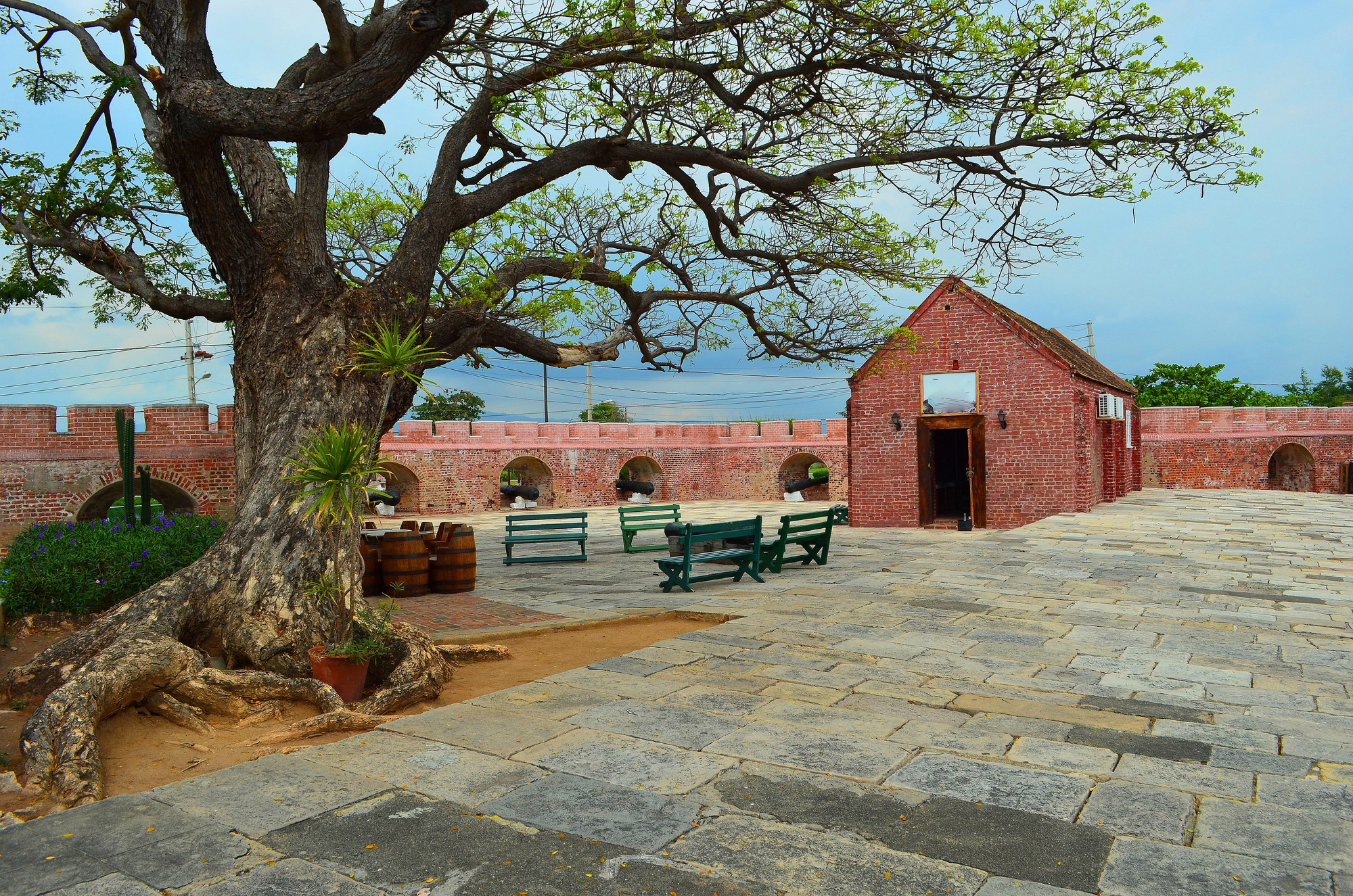
The Most Accessible Underwater History in the Caribbean
In June of 1692, Port Royal was one of the wealthiest and most notorious cities in the Western Hemisphere. A thriving hub of Caribbean trade, it was also a magnet for pirates, merchants, and adventurers of every kind. Then, in the span of two minutes, a catastrophic earthquake sent two-thirds of the city sliding into the sea. In two minutes, the sea swallowed buildings, streets, wharves, and thousands of lives whole.
What makes Port Royal uniquely valuable is not just its dramatic story. It is the fact that the city sank so quickly that it was essentially sealed in time. Kind of like a maritime Pompeii.
Because Port Royal sank so suddenly, the sea preserved everyday objects, building interiors, and street layouts exactly as they were, something centuries of gradual abandonment could never have achieved. Researchers have used Port Royal to understand not just this city, but to develop insights into how other submerged coastal settlements around the world may have met their end.
Port Royal is one of the few family-friendly sunken city tours around the world that combines a genuinely riveting historical narrative with easy accessibility from a major tourist destination. Jamaica is already a beloved family vacation spot, and adding a visit to the Port Royal archaeological zone transforms a beach holiday into something far more layered and memorable.
Glass-bottom boat tours offer families a non-diving way to see the underwater ruins, while older teens and adults with diving certifications can get considerably closer.
The story of Port Royal also opens the door to a broader conversation about how and why cities disappear. It is one of the best entry points to underwater archaeology family travel experiences available anywhere in the Caribbean.
Practical Guidance for Families Visiting Sunken Cities
Do You Need Scuba Certification to See Underwater Ruins?
Families planning to visit sunken cities with their kids ask the same question almost every time: do you actually need scuba certification to experience these places? The short answer is no, not always.
Many of the world’s most extraordinary underwater ruins rise up from shallow water, close enough to the surface that a snorkel mask and a sense of wonder are the only equipment your family needs. Pavlopetri in Greece, the sunken city of Baia in Italy, and several sections of Port Royal in Jamaica are accessible to confident snorkelers without any dive certification.
That said, scuba access opens significantly more of most sites. For families with teenagers or adults who hold an open-water certification, a guided dive at any of these locations will reveal architectural details and spatial context that a snorkeler simply cannot access.
If your family is considering this kind of travel and no one currently holds a certification, enrolling in an open-water course before your trip is a worthwhile investment.
How to Find Family-Friendly Sunken City Tours Around the World
Look for underwater ruins where a knowledgeable guide handles the access, structures the experience, and lets your kids focus entirely on what they came to see. Look for destinations with established underwater archaeological parks, glass-bottomed boat tours, or licensed dive operators who specialize in heritage diving. These structured experiences ensure both the safety of your family and the protection of the archaeological sites themselves.
Working with a luxury travel advisor who specializes in this kind of itinerary is the most efficient path to getting it right. Access to some sites is restricted. Timing matters. The right local operator makes an enormous difference. And building a multi-destination itinerary around sunken cities requires a level of logistical coordination that is genuinely complex to manage independently.
What Age Is Right for a Visit to one of These Sunken Cities with Family?
Underwater ruins travel is remarkably age-inclusive, which makes it one of the strongest choices for multigenerational family vacations. The sunken cities you can visit with your family range from shallow, snorkel-ready sites to deeper, dive-accessible ruins. This means every age group and comfort level can participate in some meaningful way.
Young children who are confident in the water can snorkel at shallow sites with a parent alongside. Older children and teenagers with some snorkeling or diving experience can engage at a deeper level. Grandparents who do not swim can participate from glass-bottomed boats or simply enjoy the above-water history, culture, and landscape that surrounds every one of these destinations.
The best time to take your family to see sunken cities is whenever your children are old enough to understand what they are looking at. The memory of floating above a five-thousand-year-old street is one that does not require a caption to be extraordinary.
Why Sunken Cities Make the Best Family Vacation Experiences
What makes family adventure travel around underwater ruins different from any other kind of family vacation is the combination of physical experience and historical weight. Your children are not passive observers. They are actively moving through history, breathing it in, feeling the cool resistance of the water as they hover above something that no living person built. That kind of embodied learning does not come from a textbook, a documentary, or even the most beautifully curated museum on earth.
The sunken cities you can visit with your family are not just travel destinations. They are experiences that reshape how a child understands the world. They are the trips that make your children the most interesting people in any room for the rest of their lives. The ones who have been to places others have only heard of. Who have seen things others only read about.
When you are ready to plan a family vacation around ancient underwater ruins, extraordinary history, and experiences your family will carry for decades, I build exactly that kind of itinerary.
So, are you ready to plan a family vacation to visit a sunken city and make memories?
If you said yes, I would like to invite you to schedule a planning session with me by clicking here. Clicking on this link will take you directly to my digital calendar to schedule a time that is convenient for you.
If you are not ready to plan a family vacation to see underwater ruins or another destination, you can easily sign up for my newsletter here. This will ensure you always receive all the exciting travel information I share.

Tracy is the owner of Elite Travel Journeys, a luxury travel agency dedicated to crafting extraordinary, memory-making journeys for families, multigenerational groups, empty nesters, and solo female travelers. A proud military veteran and President of the Central PA Chapter of ASTA, Tracy brings both discipline and deep passion to everything she does. With a particular love for river cruising, especially Europe’s enchanting Christmas Markets, she has been turning travel dreams into life-changing experiences since 2014. Tracy believes that extraordinary travel doesn’t just take you somewhere new; it changes who you are.
Enter your Name and best Email Address to receive
On Your Next Family Vacation
We respect your privacy and will never share or sell your information.
3 Ways to See It All in Alaska


On Your Next Family Vacation
Click here for 10 Exciting Family Adventures
You Can Plan
NOW